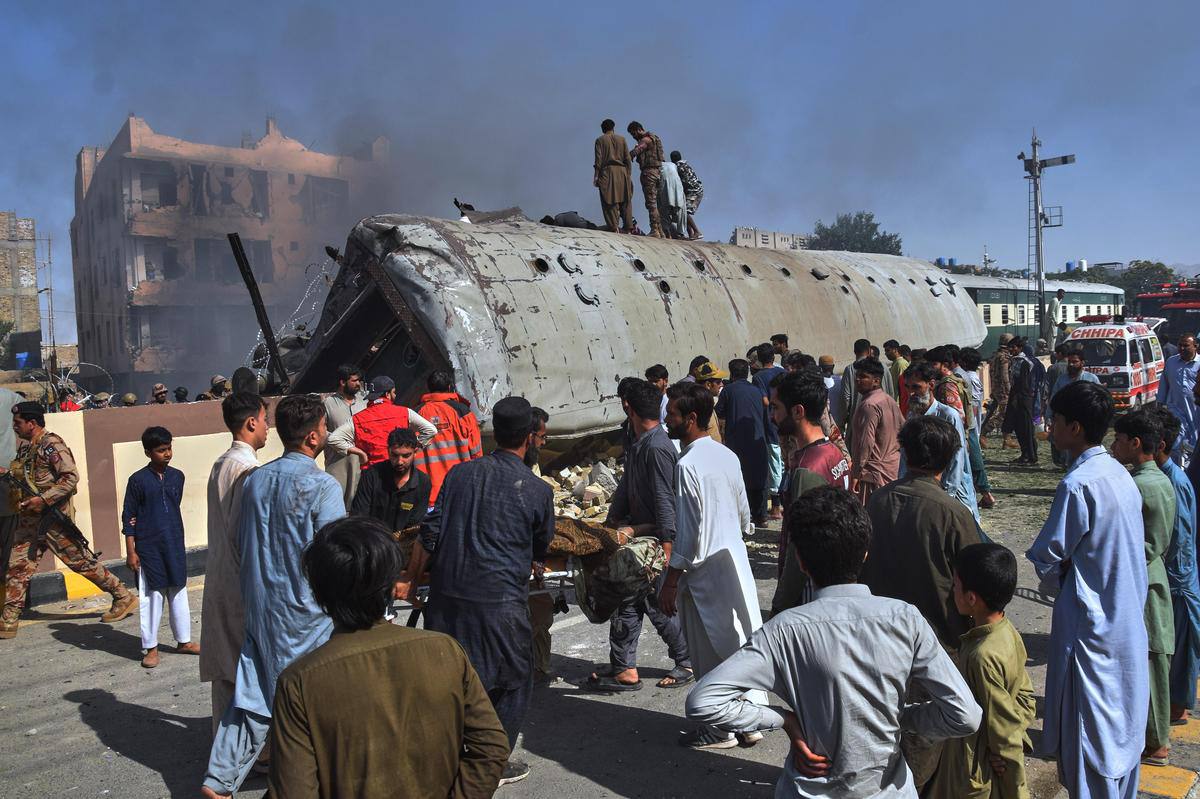

The devastating vehicle-borne explosive attack on a passenger train near Quetta’s Chaman Phatak this Sunday, which claimed the lives of at least 24 to 30 people and left over 47 injured, is a profound and senseless tragedy. The loss of human life—including innocent civilians caught in the blast radius—deserves unequivocal condemnation. The Baloch Liberation Army (BLA) has claimed responsibility, asserting the strike targeted Pakistani military personnel onboard. Predictably, Islamabad has reverted to its standard playbook: denouncing the violence, declaring emergencies, and casting blame on “external elements.” Yet, to view this carnage merely as an isolated act of terrorism is to be willfully blind to the agonizing reality on the ground. Sunday’s bloodshed is the explosive, inevitable symptom of decades of systemic state repression, relentless resource exploitation, and the suffocating militarization of a deeply marginalized province.
For years, the Pakistani state has attempted to enforce a fragile illusion of control in Balochistan through an iron-fisted security apparatus. Beneath this veneer lies a harrowing human rights crisis centered on the chilling practice of enforced disappearances—a cruel tactic systematically employed to silence dissent. The statistics present a damning indictment of the state’s approach. In 2025, human rights monitors, including the Baloch Yakjehti Committee (BYC), and the Paank human rights department, documented between 1,223 and 1,355 enforced disappearances. By early 2026, over 1,000 of these individuals remain unaccounted for, swallowed by a clandestine network of unofficial detention centers.
The victims of this shadow war are not armed insurgents; they are students, journalists, activists, and ordinary citizens. Security forces, notably the Frontier Corps and intelligence agencies, operate with near-total impunity, conducting midnight raids and checkpoint abductions. For countless Baloch families, the agonizing wait for a missing loved one often ends weeks or months later with the discovery of a mutilated corpse. This grim “kill and dump” policy has normalized terror for the civilian population and entirely stripped the province of basic legal due process.
When the Baloch people have attempted to channel their grief and frustration into democratic, non-violent avenues, the state has responded with overwhelming force. The crackdown on peaceful civil society movements lays bare Islamabad’s refusal to engage in genuine dialogue. The BYC, led by figures like Dr. Mahrang Baloch, has organized massive peaceful marches demanding basic constitutional rights, accountability, and justice for the disappeared. The state’s answer has been internet blackouts, baton charges, and mass arrests. Dr. Mahrang Baloch and several key leaders currently remain in detention on severe terrorism charges, their remands repeatedly extended by compliant courts despite international outcry. The data from March 2025 alone provides a horrific snapshot of this suppression: monitors recorded 151 enforced disappearances and 80 extrajudicial killings amid sweeping crackdowns on peaceful protests. When non-violent avenues for justice are violently barricaded, it inevitably fuels the desperate narrative of armed resistance.
Compounding this physical repression is the blatant economic exploitation of Balochistan. The province is Pakistan’s most resource-rich region, boasting vast reserves of natural gas, copper, and gold, alongside the highly strategic deep-water port of Gwadar under the China-Pakistan Economic Corridor (CPEC). Yet, the Baloch people remain the poorest in the country. Since the discovery of the Sui gas fields in the 1950s, the province has fueled Pakistan’s industrial and domestic energy needs, while its own villages largely lack basic utilities. The wealth generated from Balochistan’s soil and shores flows outward, leaving locals to contend with displacement, environmental degradation, and the heavy footprint of foreign mega-projects. This dynamic is widely, and rightfully, perceived by locals as internal colonization.
Pakistan’s reliance on military might to crush this discontent has proven to be a catastrophic failure. Broad-brush security operations, including ground sweeps and airstrikes, frequently result in civilian casualties and collective punishment. Rather than stamping out the insurgency, these brutal tactics act as the greatest recruiting tool for separatist groups like the BLA. The state’s refusal to differentiate between peaceful activists and armed militants has created a self-fulfilling prophecy, pushing an increasingly desperate youth toward militancy.
The United Nations, Amnesty International, and Human Rights Watch have repeatedly sounded the alarm over these abuses, though state-imposed restrictions on independent monitors make full verification difficult. Polite expressions of international concern, however, are no longer enough. The Quetta train blast is a grim reminder of the human cost of ignored grievances. Stability will never be achieved down the barrel of a gun. It requires a profound pivot from the state: allowing independent international investigations, immediately releasing political prisoners, permanently halting the practice of enforced disappearances, and initiating genuine dialogue on provincial autonomy and resource rights. Until Islamabad addresses the root causes of this conflict, the bloody cycle of resistance and repression will persist.


