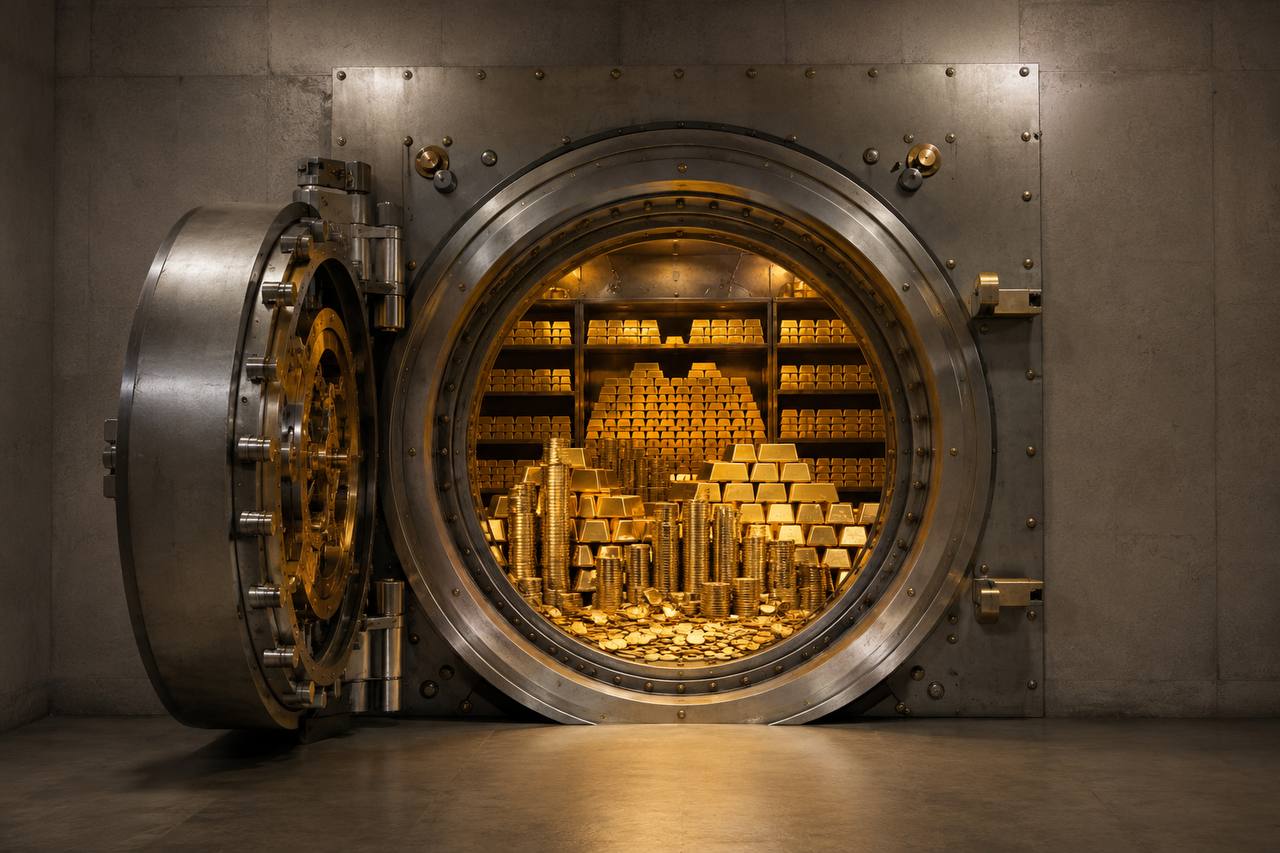

The United States held 8,133.46 tonnes of gold reserves as of early 2026, retaining its position as the world’s largest sovereign holder — a lead unbroken since the post-Bretton Woods era. Germany ranked second at 3,352.65 tonnes, with Italy at 2,451.84 tonnes and France at 2,436.88 tonnes, according to the World Gold Council (WGC).
The Full Top 10
Top 10 Countries by Gold Reserves, 2026
| Rank | Country | Gold Reserves (Tonnes) | % of Forex Reserves |
|---|---|---|---|
| 1 | United States | 8,133.46 | ~74% |
| 2 | Germany | 3,352.65 | ~73% |
| 3 | Italy | 2,451.84 | ~69% |
| 4 | France | 2,436.88 | ~71% |
| 5 | Russia | 2,332.74 | ~29% |
| 6 | China | 2,313.46 | ~5% |
| 7 | Switzerland | 1,040.00 | ~8% |
| 8 | India | 880.52 | ~16.7% |
| 9 | Japan | 845.97 | ~5% |
| 10 | Netherlands | 612.45 | ~67% |
Why Central Banks Are Buying
Global central bank gold purchases reached 1,045 tonnes in 2024 — the third consecutive year above 1,000 tonnes — per the WGC’s Gold Demand Trends report published in January 2025. The primary driver is de-dollarisation: emerging market central banks are cutting exposure to US Treasury-linked assets, a trend that sharpened after Russia’s foreign exchange reserves were frozen in 2022.
China’s gold-to-forex ratio sits at roughly 5%, against Germany’s 73%. That gap indicates Beijing has room — and apparent intent — to keep buying. The People’s Bank of China paused briefly in mid-2024 before resuming, adding 10 tonnes in December 2024. China has already surpassed Switzerland’s 1,040-tonne level, holding 2,313.46 tonnes as of March 2026, and is currently ranked 6th globally.
India’s Strategic Shift
The Reserve Bank of India (RBI) added over 57 tonnes in the fiscal year ending March 2025 — its largest annual increase in the last seven years. India also repatriated 100 tonnes stored at the Bank of England to domestic vaults in 2024. Gold now accounts for roughly 16.7% of India’s total foreign exchange reserves, up from under 6% in 2020. With spot gold trading around $4,700 per troy ounce in May 2026, that holding carries material balance-sheet weight.
ℹ️ Why Gold Reserves Matter
- Gold carries no counterparty risk — it cannot be frozen by a foreign government.
- Central banks use it to signal financial stability and underpin sovereign credit.
- A higher gold share reduces vulnerability to dollar volatility and US sanctions exposure.
- At $4,700-plus per troy ounce, reserve valuations are a live balance-sheet issue for finance ministries.
What Comes Next
The WGC will publish its next quarterly Gold Demand Trends update in late July 2026, confirming whether central bank purchases have held above the 1,000-tonne annual run-rate. If China sustains its 2024-25 accumulation pace, it will tighten the race with fifth-placed Russia — a shift that would reshape the top half of the global rankings for the first time in a decade.
FAQ
Which country has the most gold in 2026?
How much gold does India hold in 2026?
Why are central banks buying so much gold?


