
The repatriation of the Chola copper plates from the Netherlands brings primary historical evidence back to their place of origin. These durable copper records offer detailed insights into Chola governance, land administration, religious tolerance, including endowments to Buddhist institutions, and royal lineage. They will now educate future generations about Tamil literary and cultural achievements, as well as maritime accomplishments. This event also deepens diplomatic and cultural bonds between India and the Netherlands, while setting a constructive precedent for the return of historically significant artefacts. For India, it reaffirms pride in its civilizational contributions and counters earlier narratives that understated indigenous seafaring capabilities.
The return of the Chola plates strengthens public awareness of these deep-rooted traditions at a time when maritime strategy is gaining renewed national focus. The copper plates and associated inscriptions reflect the Cholas’ understanding of sea power as essential for protecting trade and enforcing agreements. When the Srivijaya ruler disregarded agreements, the naval response compelled adherence and restored equilibrium in the sea lanes. This approach—using maritime strength to safeguard economic lifelines—echoes through centuries of Indian Ocean history.
The Strategic Dimension of Historical Influence
Today, the Indian Ocean remains critical to global commerce. A significant portion of India’s trade by volume and its energy imports transits these waters. The Strait of Malacca continues to be one of the busiest maritime chokepoints worldwide. India’s expanding blue economy, including modern ports, shipping, fisheries, offshore resources, and marine tourism, builds directly on this historical foundation.
The Indian Navy has emerged as a prominent net security provider in the region, conducting anti-piracy patrols, disaster relief, and cooperative exercises with friendly nations. Programmes for port modernisation and coastal development further enhance maritime capacity.
The Chola Naval Empire: Scale, Strategy, and Reach
The Chola Empire reached its maritime zenith under Rajaraja I (r. 985–1014 CE) and Rajendra I (r. 1014–1044 CE). Rajaraja I built a strong navy that helped secure Sri Lanka and the Maldives. His son took this capability further with one of history’s most audacious naval expeditions.
In 1025 CE, Rajendra Chola I launched a major campaign against the Srivijaya Empire, centred in Sumatra. Srivijaya controlled the vital Strait of Malacca and imposed burdensome tolls on merchants, threatening Chola trade with Southeast Asia and China. The Chola fleet crossed the Bay of Bengal and struck multiple targets, including Kadaram (Kedah on the Malay Peninsula), Palembang, and other key ports. Chola inscriptions record victories over Srivijaya, Malaiyur, and several regional powers, showcasing extraordinary planning, logistics, and naval strength.
This was not random raiding but a calculated assertion of interests. By weakening Srivijaya’s monopoly, the Cholas helped secure safer sea lanes for their traders. Tamil merchant guilds like Manigramam and Ayyavole flourished under this protection, extending commercial networks across the region. The expedition reinforced Chola prestige and opened new avenues for cultural and economic exchange.
Key Facts on Chola Maritime Capabilities:
- The navy featured specialised vessels: large combat ships (Dharani), troop transports capable of carrying hundreds of soldiers, patrol boats, and cargo carriers.
- Ships were built with high-quality teak and other woods sourced from the Western Ghats, using advanced stitched-plank construction for superior flexibility in rough seas.
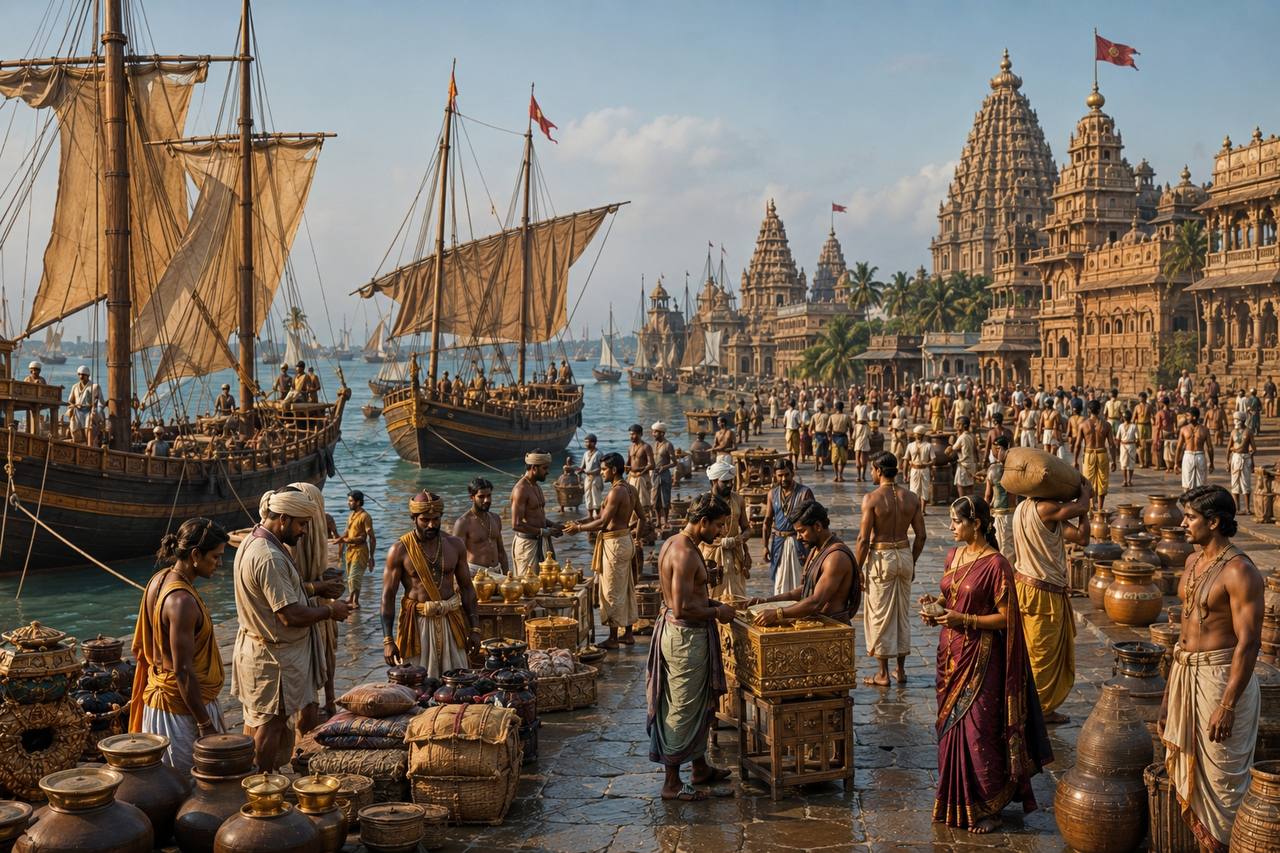
- Major ports such as Nagapattinam functioned as bustling shipyards and international trade hubs.
- Exports included spices, fine textiles, pearls, gems, and ivory, exchanged for horses, metals, and other goods from distant markets.
- Chola embassies reached China, and successful campaigns brought back valuable artefacts to adorn capitals like Gangaikonda Cholapuram.
This maritime power enabled the Cholas to influence vast stretches of the Indian Ocean without establishing permanent distant colonies, relying instead on strategic reach, naval deterrence, and commercial partnerships.
Reviving Ancient Shipbuilding Traditions
A cornerstone of Indian maritime success was its distinctive shipbuilding technology. Economist and author Sanjeev Sanyal has actively demonstrated this heritage through the “Stitched Ship Project,” which reconstructs ancient vessels using the traditional tankai technique. In this method, wooden planks are stitched together with coir ropes and sealed with natural resins and oils, avoiding iron nails.
The resulting hulls were flexible and resilient, perfectly suited to the Indian Ocean’s monsoon winds, swells, and coral-filled waters. This technology has roots stretching back over two millennia, with evidence from the Gupta era and earlier. The project revives knowledge preserved by coastal communities and highlights how Indian shipwrights created durable ocean-going vessels using indigenous materials and skills.
India’s 7,516 km coastline has long supported advanced maritime activity. The Harappan dockyard at Lothal (c. 2500 BCE) stands as one of the world’s earliest engineered harbours. Ports like Arikamedu, Mamallapuram, and Nagapattinam later became thriving centres of global trade. Classical texts such as the Periplus of the Erythraean Sea vividly describe the volume and richness of commerce with South India. The Cholas inherited and amplified this legacy, transforming maritime enterprise into an instrument of state power.
India’s Broader Maritime Heritage
India’s seafaring history predates the Cholas by many centuries:
- The Indus Valley Civilisation demonstrated sophisticated dockyard engineering and standardised maritime trade systems.
- Mauryan and Gupta periods saw expanded networks reaching the Red Sea and Southeast Asia.
- Southern kingdoms—Chera, Chola, and Pandya—competed and cooperated in oceanic commerce for centuries.
- Coastal communities preserved shipbuilding and navigational knowledge across changing political eras.
Maritime trade drove prosperity, urban growth, and cultural exchange. Indian goods were prized across the ancient world, while incoming influences enriched Indian civilisation. The Chola era represented a high point where naval capability, commercial ambition, and cultural confidence came together powerfully.
Sailing Forward on Ancient Foundations
As India strengthens indigenous shipbuilding, modernises its navy, and expands its blue economy, the Chola legacy provides powerful inspiration. From stitched-plank ships braving monsoon oceans to today’s advanced indigenous vessels and port infrastructure, the continuity of maritime excellence is evident.
The copper plates, with their elegant Tamil inscriptions, celebrate an era when Indian mariners and rulers confidently navigated and influenced distant horizons. Their return enriches the national heritage and underscores the importance of oceanic awareness for India’s future.
With its vast coastline, central location in the Indian Ocean, and centuries of accumulated experience, India is naturally positioned as a key maritime power. By embracing this proud legacy—vividly illustrated by the Cholas and preserved in these copper plates—the nation is reaffirming its historical sovereignty and charting a secure, prosperous, and outward-oriented course on the seas.