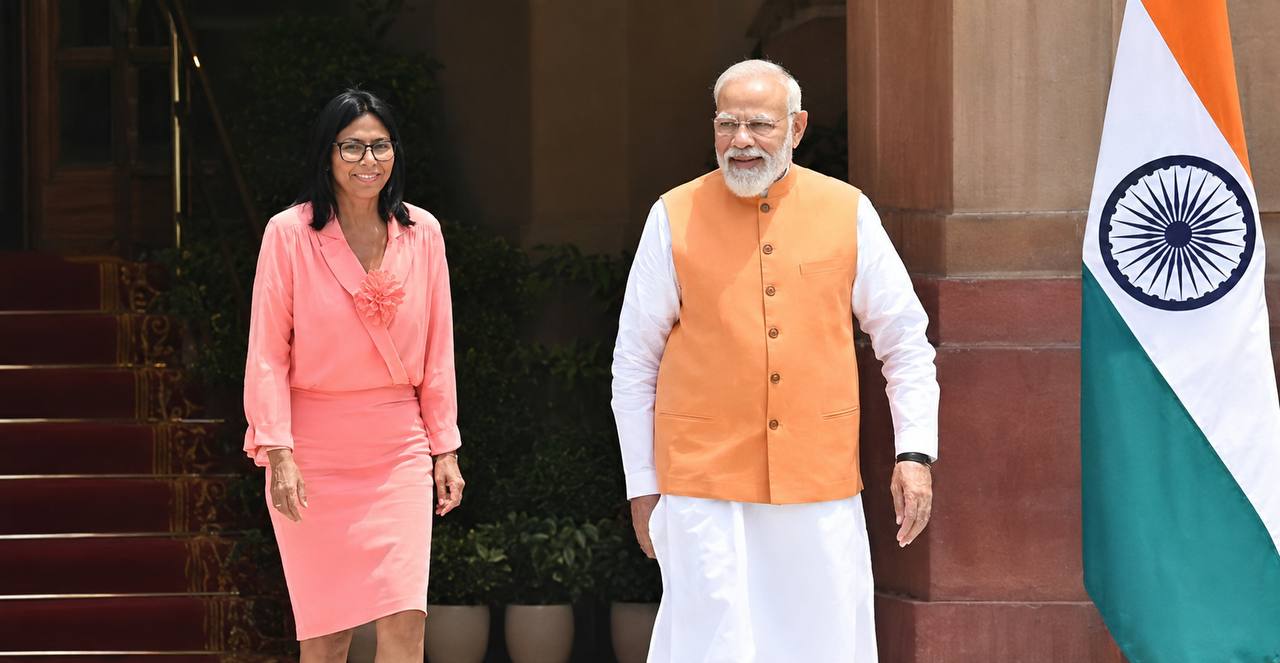

The critical June 4, 2026, meeting in New Delhi between Venezuelan Acting President Delcy Rodríguez and Indian Prime Minister Narendra Modi marks a profound realignment in global energy geopolitics. While the official agenda highlighted cooperation across pharmaceuticals, healthcare, and critical minerals, the driving force behind the diplomatic summit was undeniable: securing long-term crude oil supply agreements for an energy-starved India amidst unprecedented global supply chain disruptions.
This high-profile engagement is no ordinary bilateral negotiation. It represents the visible execution of a sophisticated, US-facilitated strategy designed to rewire global oil flows and stabilise energy markets currently crippled by conflict in the Middle East.
The Caracas Shift: From Regime Change to Managed Oil Flows
The diplomatic groundwork for this India-Venezuela breakthrough was laid in early 2026. Following a targeted operation by US special forces in January that resulted in the capture of Nicolás Maduro, Venezuela’s Supreme Court elevated Vice President Delcy Rodríguez to Acting President.
Rather than forcing an immediate and potentially destabilising regime collapse, Washington opted for a strategy of conditional continuity—maintaining the existing power structure under strict guardrails to rapidly restore oil production.
By swiftly lifting key sanctions on Petróleos de Venezuela (PDVSA), the US engineered a vital rebound in Venezuelan crude exports. However, this relief was highly structured: oil revenues are now directed into US-controlled accounts to oversee financial flows, and major export destinations require explicit Washington approval.
When US Secretary of State Marco Rubio publicly confirmed Rodríguez’s impending India trip in late May, he explicitly framed the visit as an extension of US-India energy cooperation. In effect, Washington removed the political bottleneck in Caracas, revived upstream production, and is now actively steering Venezuelan barrels toward friendly, neutral buyers like New Delhi.
Key Events Leading to the India-Venezuela Summit
- Early 2026 — Diplomatic groundwork for India-Venezuela breakthrough laid.
- January 2026 — US special forces capture Nicolás Maduro; Delcy Rodríguez elevated to Acting President.
- Late May 2026 — US Secretary of State Marco Rubio publicly confirms Rodríguez’s impending India trip.
- May 2026 — US becomes largest buyer of Venezuelan crude, followed by Indian refiners.
- June 4, 2026 — Venezuelan Acting President Delcy Rodríguez meets Indian Prime Minister Narendra Modi in New Delhi.
The Dual Chokepoint Doctrine: Weaponising Energy Geopolitics
The timing of Venezuela’s reentry into the global oil market is intricately connected to the parallel crisis in the Middle East. By confronting Iran and squeezing maritime traffic through the Strait of Hormuz, the US and its allies have constrained a vital trade artery that supplies China, India, and Western Europe.
This “dual chokepoint” strategy—restricting one major supply line while unlocking another—serves several critical geopolitical and economic objectives:
- Global Market Stabilisation: Heavy Venezuelan crude directly offsets the supply vacuum left by Middle Eastern disruptions, acting as a crucial buffer to prevent catastrophic spikes in global oil prices.
- Redirecting Strategic Flows: By re-routing oil exports that previously went to Beijing at deep discounts, Washington is systematically depriving adversaries of cheap energy while reinforcing the energy security of strategic partners like India.
- Revenue and Influence Capture: Through strict licensing and oversight, the US maintains indirect control over Venezuelan oil money. Western energy firms have also secured preferential access for trading, upstream investments, and diluent supplies.
By May 2026, the US itself became the largest buyer of Venezuelan crude; closely followed by Indian refiners who are urgently seeking alternatives to replace lost Middle Eastern volumes.
India’s Multi-Alignment Pragmatism: Securing Oil Under Pressure
For New Delhi, navigating the 2026 energy crisis demands aggressive supply diversification. The turmoil in the Strait of Hormuz directly threatens India’s traditional Gulf supply lines, elevating alternative sources to a matter of urgent national security.
India’s strategy revolves around practical multi-alignment. The country continues to import discounted Russian crude, maintains ties with Gulf suppliers where operationally viable, accelerates domestic renewable energy projects, and now deepens Latin American partnerships.
Strategic Energy Shifts for India (2026)
| Strategic Energy Shifts for India (2026) | Purpose and Benefit |
|---|---|
| Venezuelan Heavy Crude | High-volume replacement crude perfectly tailored for India’s complex refiners. |
| Russian Urals | Sustained baseload imports bypassing G7 price caps where economically viable. |
| Middle East Supplies | Restricted to operational volumes that can bypass active maritime conflict zones. |
Indian conglomerates—which possess some of the world’s most sophisticated refineries capable of processing heavy, sour Venezuelan crude—are ideally positioned to absorb these barrels. Deepening ties with the Rodríguez administration allows India to insulate its domestic economy from severe Middle Eastern price shocks without violating the newly established US sanctions architecture.
Structural Risks in the Tripartite Supply Chain
Despite the strategic synergy between Washington, Caracas, and New Delhi, this newly formed supply chain carries significant structural vulnerabilities:
- Infrastructure Decay in Venezuela: Decades of underinvestment, asset neglect, and an exodus of technical talent mean that Venezuela’s domestic production recovery faces severe physical constraints.
- Political Volatility: Rodríguez’s transitional presidency remains provisional. Hardline factions within the military still wield considerable influence, making long-term stability uncertain.
- Logistical and Compliance Friction: Shipping crude from the Orinoco Belt to India requires long-haul maritime routes, adding significant transit times and transport premiums compared to the Persian Gulf. Furthermore, payment mechanisms remain highly dependent on US regulatory approvals.
Conclusion: A Re-engineered Global Energy Map
The June 2026 summit between Delcy Rodríguez and Narendra Modi transcends a typical commercial trade visit. It is the operational face of a profoundly altered global energy landscape.
By functioning as both the disruptor in the Middle East and the facilitator in Latin America, the United States has asserted unprecedented indirect control over global crude flows. For India, the Venezuelan oil pitch provides a vital economic lifeline at a moment of acute geopolitical vulnerability. Whether this immediate transactional arrangement transitions into a resilient, long-term energy partnership will depend heavily on the stabilisation of Venezuela’s production infrastructure and the evolving contours of Washington’s strategic priorities.


