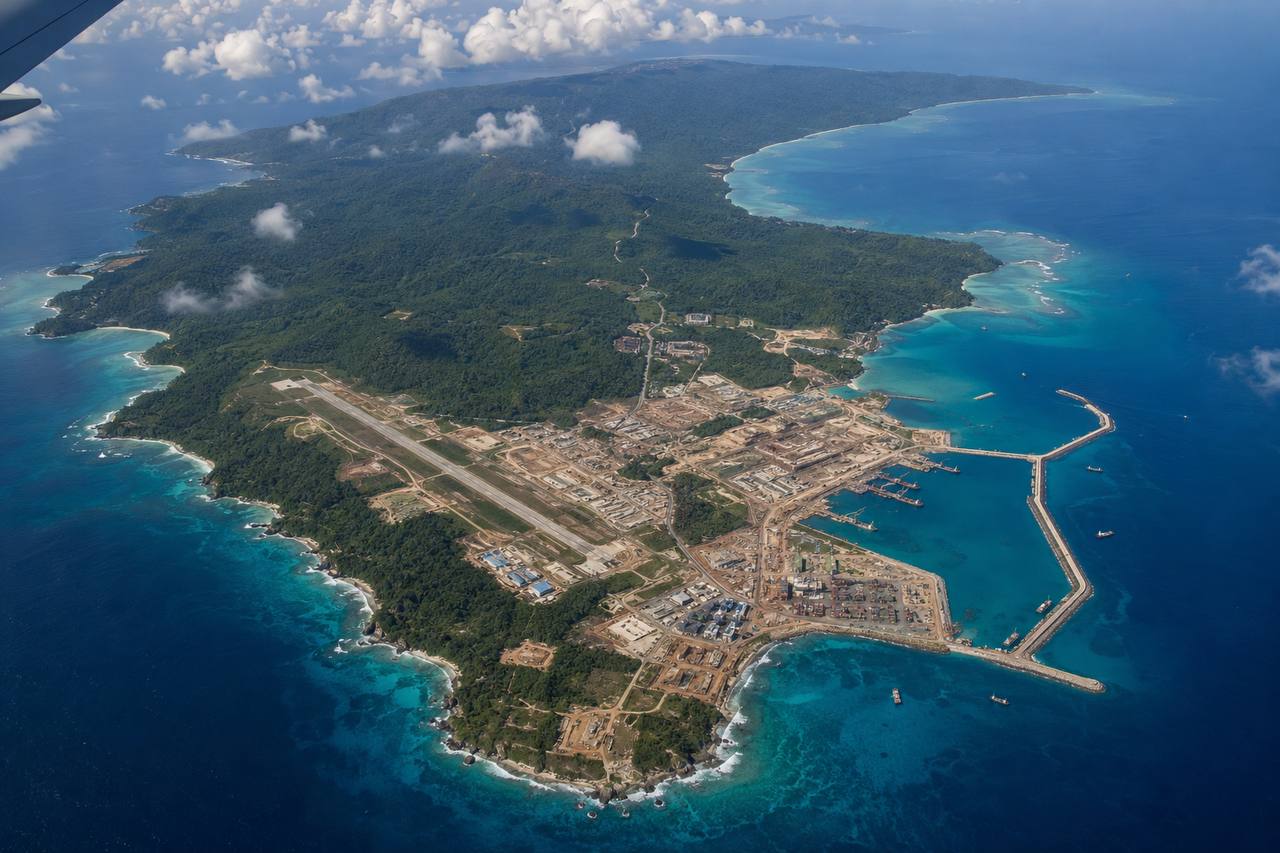

The Indian Ocean is the undisputed center of gravity for 21st-century geopolitics. At its eastern gateway lies the Strait of Malacca, a narrow maritime corridor through which the economic lifeblood of the Indo-Pacific flows. For India, dominating this approach is not a matter of ambition, but of sovereign survival. This reality is the genesis of the Great Nicobar Island Development Project—an ₹81,000 crore initiative to build a transshipment mega-port, a dual-use military airport, and a self-sustaining commercial ecosystem at the southernmost tip of the Andaman and Nicobar archipelago. Yet, as the project inches toward realization, it faces fierce domestic political opposition. When analyzed through the unforgiving lens of national security and energy independence, the activism against the Great Nicobar Project transcends domestic political theater; it operates as a strategic accelerant for interests fundamentally opposed to India, primarily Beijing.
To understand the stakes, one must understand the dual imperatives of the Great Nicobar Project: military deterrence and energy security. For decades, strategic planners have pointed to China’s “Malacca Dilemma”—its overwhelming reliance on the Strait of Malacca for its crude oil imports and export trade. By establishing a heavily fortified, permanent military and commercial presence on Great Nicobar, India effectively parks an unsinkable aircraft carrier right at China’s most vulnerable maritime chokepoint. It grants the Indian Navy unparalleled Intelligence, Surveillance, and Reconnaissance (ISR) capabilities, transforming the eastern Indian Ocean into a transparent zone that neutralizes the stealth of Chinese submarine incursions.
However, the military calculus is only half the equation. A strategic outpost of this magnitude cannot exist in an economic vacuum; it requires power grids, logistics networks, and deepwater ports to sustain its operations. The definitive validation of this commercial-military integration arrived just hours ago.
Yesterday, the strategic narrative shifted irreversibly. On June 5, 2026, Petroleum and Natural Gas Minister Hardeep Singh Puri took to X to announce a monumental development:
An ocean of energy opportunities reinforced in the Andaman Sea! Very happy to report the presence of natural gas in Sri Vijayapuram-3, an exploratory well drilled by Oil India Ltd. 15 km off the east coast of the Andaman Islands.
Hardeep Singh Puri, Petroleum and Natural Gas Minister · X · June 5, 2026
Drilled to a depth of over 1,900 meters in the Eocene formation under the ambitious Samudra Manthan Mission, the well established the presence of natural gas through continuous flaring. Marking the second successful hydrocarbon find in the basin in just nine months, this discovery does more than just excite energy markets; it fundamentally alters the Great Nicobar debate by providing the ultimate economic anchor for the island’s fortification.
The offshore gas discovery instantly cements the economic viability of the Great Nicobar Project. The planned infrastructure is no longer just about capturing transshipment revenue from foreign cargo; it is the foundational architecture required to extract, process, and secure India’s own offshore energy wealth, drastically reducing reliance on volatile Middle Eastern imports.
Despite these existential national imperatives, a coordinated opposition campaign, spearheaded by figures like Rahul Gandhi, has sought to stall the project. Cloaked in the language of environmentalism and tribal rights, the activism alleges that the military necessity is a smokescreen designed to hand pristine rainforests to private conglomerates. They argue for a minimalist approach—simply expanding the existing naval air station, INS Baaz—while vehemently opposing the commercial township, the mega-port, and the power plants.
This line of opposition represents a profound miscalculation of modern geopolitical mechanics. A radar tower and a runway do not constitute a formidable deterrent if they are entirely reliant on the distant Indian mainland for every drop of fuel, every replacement part, and every commercial supply line. Refusing to build the economic and energy infrastructure necessary to sustain the military presence is tantamount to building a fortress with no supply lines.
Furthermore, the relentless litigation, protests, and political grandstanding serve a clear beneficiary: China. In the zero-sum game of the Indo-Pacific, any delay in India’s fortification of the Andaman Sea is a strategic victory for Beijing. As long as Great Nicobar remains undeveloped, the People’s Liberation Army Navy (PLAN) enjoys a critical window of time. It affords China the breathing room to build alternative overland energy corridors, expand its own blue-water fleet, and solidify its encirclement strategy without facing a permanent, heavily armed Indian tollbooth at its primary maritime gate.
When domestic political factions actively work to dismantle the commercial and infrastructure pillars of the Great Nicobar Project—as seen when Rahul Gandhi leveraged his recent island visit to launch a massive World Environment Day campaign to stoke dissent against the development—they are inadvertently, or perhaps callously, doing Beijing’s strategic heavy lifting. By fighting to deny India its own deepwater energy reserves and fighting to keep its most critical maritime chokepoint unfortified under the banner of “green over greed,” this activism champions a policy of calibrated capitulation. The opposition’s narrative demands that India prioritize the preservation of a static ecological state over the dynamic defense of its borders, its economy, and its energy independence.
The reality is that great powers do not outsource their security, nor do they leave their most vital geographic assets fallow in the face of an expanding adversary. The environmental mitigation strategies—including coral translocation and compensatory afforestation—are necessary steps in executing this vision responsibly, but they cannot become paralyzing vetoes. The discovery of natural gas in the Andaman basin fundamentally rewrites the narrative: Great Nicobar is no longer just about looking outward to threaten an adversary; it is about looking downward to secure India’s own prosperity.
The Great Nicobar Project is the linchpin of India’s eastern maritime defense and its future energy independence. Activism that seeks to sabotage this project, regardless of its ideological packaging, materially degrades India’s national security apparatus. It ensures that the nation remains dependent on foreign oil, vulnerable to maritime blockades, and structurally disadvantaged against a belligerent neighbor. In the unforgiving arena of global power projection, opposing the Great Nicobar Project is not a defense of the environment; it is a surrender of the frontier.