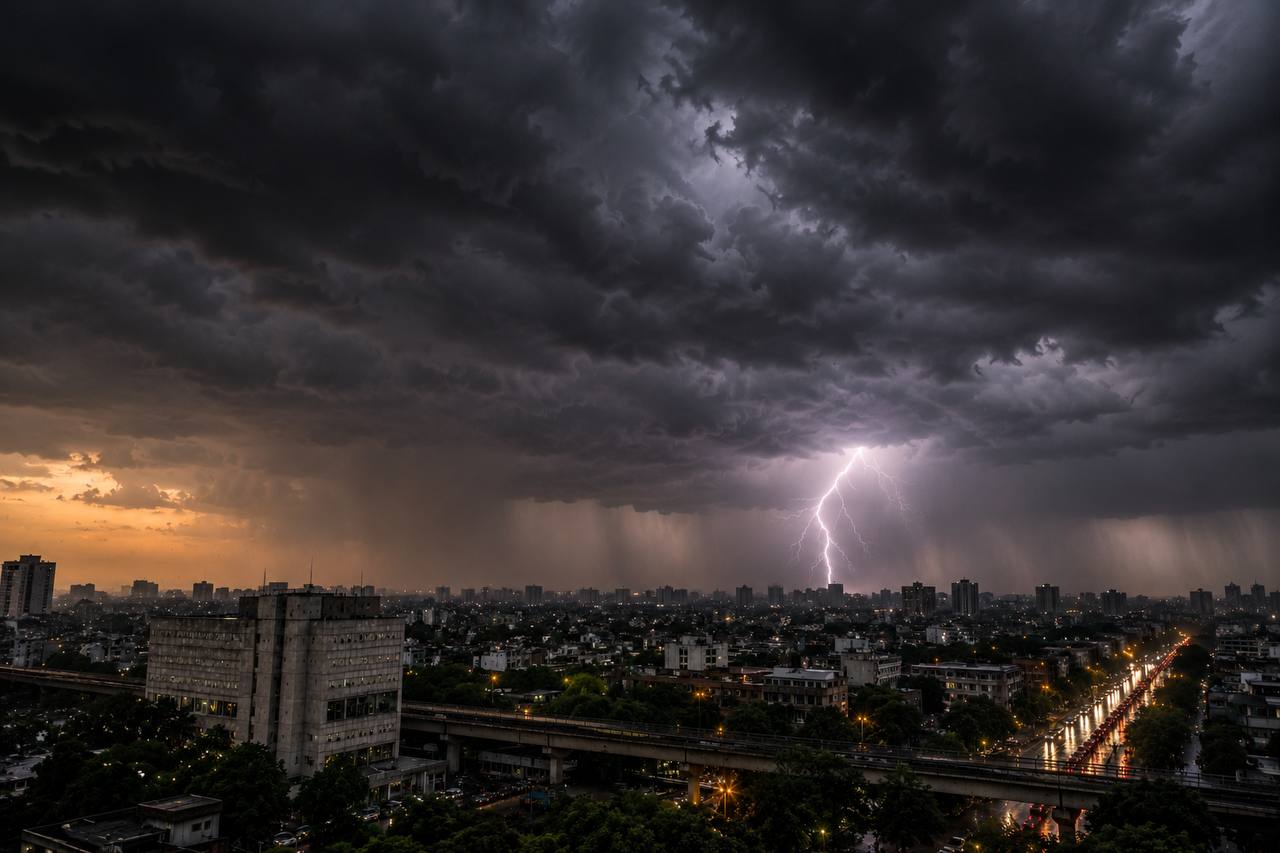

The India Meteorological Department (IMD) issued an orange alert for Delhi on 28 May 2026, warning of simultaneous thunderstorms, cloud-to-ground lightning, and hailstorms across the capital — and rain has already begun falling across the NCR, ending a fortnight of punishing heat.
The rain arrives as a direct result of north-westerly winds finally pushing through after being suppressed for weeks — a suppression pattern consistent with El Niño’s residual influence on the western disturbance track over the Indo-Gangetic Plain. Once those winds broke through, convective activity built rapidly over Delhi, producing the squall conditions IMD flagged this morning.
The eight districts under immediate risk span both Delhi and its satellite cities: central Delhi, South Delhi, North Delhi, Dwarka, Gurugram, Noida, Faridabad, and Ghaziabad. Residents across all eight face exposure to sudden squalls, hail that can reach golf-ball size in isolated cells, and fast-moving lightning strikes.
Why This Alert Matters
An orange alert — the second-highest tier in IMD’s four-level colour-coded system — signals that the weather is severe enough to disrupt daily activity and demands preparation. It sits one step below a red alert, which requires immediate protective action.
The National Crime Records Bureau (NCRB) recorded over 2,500 lightning fatalities across India in 2023 alone, with the bulk concentrated in the May–June pre-monsoon window when convective storms are most intense. Delhi’s roughly 33 lakh outdoor daily-wage workers — construction labourers, delivery riders, and street vendors — carry the highest exposure, as they have no automatic shelter when a squall line moves in.
The precedent from May 2024 is instructive: a comparable pre-monsoon squall hit Delhi with wind speeds of 80 kmph, uprooted 150 trees, and cut power across 40 colonies.
What the Forecasters Are Watching
Delhi’s pre-monsoon thunderstorm season typically runs from mid-May to mid-June, ahead of the southwest monsoon’s formal onset. IMD has historically placed monsoon arrival over Delhi between 27 June and 5 July. Today’s system sits squarely within the climatological window, but the north-westerly break that triggered it suggests the convective pattern could persist over the next 48 to 72 hours if daytime heating continues to fuel storm cells.
IMD’s standard orange-alert guidance instructs residents to avoid open fields, elevated ground, and large trees during active lightning periods. Motorists should pull over away from trees and hoardings. Standing crops in Delhi’s peripheral farm belts face direct hail risk.
ℹ️ IMD Colour-Coded Alert System
- Green: No action needed — normal weather
- Yellow: Watch — weather may worsen; stay updated
- Orange: Be prepared — disruption likely; take precautions
- Red: Take action — severe weather; stay indoors
Tracking the Alert
IMD updates district-level warnings every three hours during active alert periods. Residents can monitor live alerts at mausam.imd.gov.in and via the Damini lightning-alert app, which issues push notifications for strikes within a 20 km radius. IMD’s evening bulletin on 28 May 2026 will confirm whether the orange alert extends into 29 May or is stepped down, depending on how the convective system tracks overnight.
FAQ
What does an IMD orange alert mean for Delhi residents?
Which districts are covered by today's orange alert?
How do I get real-time lightning warnings in Delhi?


