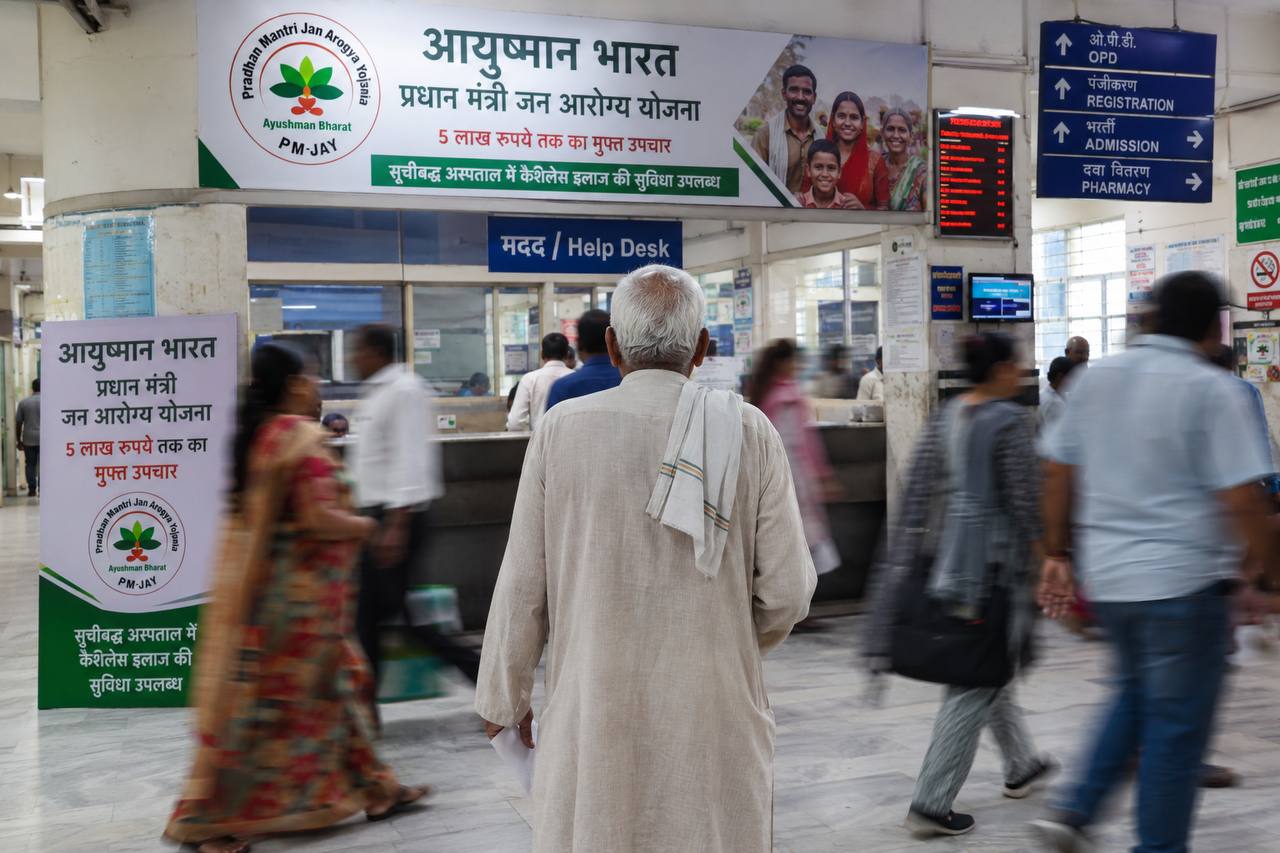

For nearly seven years, West Bengal stood as the premier outlier in India’s shifting healthcare landscape. It was the lone major state to consistently slam the gates on the Centre’s flagship health insurance initiative, the Ayushman Bharat Pradhan Mantri Jan Arogya Yojana (PM-JAY). To the casual observer, this may have looked like a dispute over fiscal allocation, administrative logistics, or actuarial viability. It was none of those things. By the admission of the previous All India Trinamool Congress (TMC) administration, the protracted standoff was born entirely from a battle over branding, credit-sharing, and political optics.
When the political guard changed, the swift pivot toward adopting PM-JAY marked the end of a long, ideologically rigid chapter and the beginning of a complex administrative integration. While the decision is a welcome course correction, it uncovers a deeper, more uncomfortable truth about Indian federalism—the cost of competitive political branding is often paid by the state’s most vulnerable citizens. Moving forward, the true test for West Bengal will not be the political triumph of a policy U-turn, but whether it can build a transparent, corruption-free framework capable of turning bureaucratic ink into actual bedside care.
The Genesis of an Avoidable Standoff
The friction began almost immediately after PM-JAY’s national launch in September 2018. West Bengal initially entered into a brief, cautious flirtation with the program, signing a Memorandum of Understanding (MoU) with the central government to run a co-branded version. However, by early 2019, the relationship imploded. The breaking point was not a disagreement over medical procedures, or hospital empanelment criteria; it was the physical card itself.
The central government insisted on distributing health cards bearing the prominent visage of Prime Minister Narendra Modi and national branding. The state government viewed this as an intolerable political encroachment—an attempt by New Delhi to extract 100% of the political capital from a scheme that required the state to foot 40% of the financial bill. Accusing the Centre of violating the spirit of cooperative federalism, and the specific clauses of the MoU, West Bengal officially withdrew from PM-JAY.
In its place, the state pivoted aggressively toward its own homegrown alternative—the Swasthya Sathi scheme. Originally launched in 2016 for government employees and civic volunteers, Swasthya Sathi was expanded in late 2020 to cover the state’s entire population. It mirrored PM-JAY’s headline promise of ₹5 lakh per family per year for secondary and tertiary care.
For the state leadership, Swasthya Sathi was a brilliant stroke of political marketing. The smart cards bore the face of Chief Minister Mamata Banerjee, the branding belonged entirely to Nabanna (the state secretariat), and the narrative was clear—Bengal takes care of its own without begging for central handouts. It was a textbook case of competitive welfare politics, where public health infrastructure was repurposed into a massive billboard for regional identity.
The True Cost of Political Isolation
To evaluate the impact of this seven-year holdout, one must look past the press releases and examine the tangible differences between the two systems. While Swasthya Sathi achieved massive enrollment numbers on paper, it suffered from structural deficiencies that PM-JAY’s broader national architecture had successfully minimized.
The most glaring flaw of Swasthya Sathi was its lack of national portability. West Bengal is a state characterized by high rates of outward migration. Hundreds of thousands of laborers, construction workers, and artisans travel from districts like Murshidabad, Purulia, and Malda to work in hubs like Delhi, Mumbai, Bengaluru, and Kerala. Under Swasthya Sathi, if a migrant worker fell critically ill or suffered a catastrophic injury in a factory in Maharashtra, their health card was little more than a useless piece of plastic. PM-JAY, conversely, offers seamless national portability, allowing a beneficiary to walk into any empanelled hospital across India and receive cashless treatment.
Furthermore, Swasthya Sathi was funded entirely out of the state’s own coffers. By rejecting PM-JAY, West Bengal willfully forfeited hundreds of crores in central health subsidies—money that could have been used to relieve its deeply strained state treasury, or reinvested into upgrading its dilapidated rural primary healthcare centers.
The Statistics of Exclusion
While Bengal stood on the sidelines, the rest of India participated in one of the largest public health experiments in human history. The national scale of PM-JAY highlights the missed opportunities for Bengal’s citizens.
Families gained cashless access to over 1,900 procedures across secondary and tertiary care in thousands of empanelled hospitals, both public and private.
In contrast, the Bengal reality during those seven years was marked by isolation. While Swasthya Sathi covered millions, it lacked national verification and interstate utility. Bengal citizens relied strictly on local infrastructure, while premium pan-India private networks remained largely inaccessible. High out-of-pocket expenses persisted for specialized tertiary treatments unavailable locally, and migrant workers from Bengal had to return home or incur heavy debt for treatment outside the state.
For ordinary Bengalis—especially the rural poor, and the vulnerable elderly—the human cost of this standoff was measured in delayed treatments, high-interest loans from local moneylenders to cover private hospital bills, and systemic medical impoverishment. The ideological pride of the state government became a regressive tax on its poorest citizens.
The Road Ahead: Crafting a Robust Hybrid Model
The newly elected government’s swift decision to reverse course and adopt PM-JAY is a welcome structural correction. However, implementing the program in West Bengal will not be as simple as changing the logos on a website, or printing new plastic cards. The state now faces the delicate challenge of transitioning from a purely state-run system to a federal hybrid model.
The smartest approach would be an intelligent integration rather than a complete replacement. Swasthya Sathi has universal coverage on paper, whereas PM-JAY is traditionally tied to the Socio-Economic and Caste Census (SECC) data, targeting the bottom 40% of the economic pyramid. If the state government abruptly scraps Swasthya Sathi, it risks triggering a massive public backlash from lower-middle-class families who fall outside the strict federal poverty definitions but still cannot afford private tertiary healthcare.
The ideal strategy is a co-branded, top-up, hybrid model, similar to those successfully deployed in states like Gujarat and Maharashtra. Under this framework, the poorest segments of Bengal’s population are migrated to PM-JAY, maximizing the inflow of 60% central funding. The remaining segments are covered under an adapted state welfare umbrella, using state funds to fill the gap. This approach preserves the universal safety net while expanding patients’ access to premium national corporate hospital chains that previously refused to touch Swasthya Sathi due to its lower rate structures.
The Structural Pitfalls of PM-JAY
However, the state administration must avoid treating PM-JAY as a flawless solution. Over the years, the scheme has faced significant structural and operational hurdles across India, and West Bengal is uniquely vulnerable to these exact failures if it lets its guard down.
1. Low Package Rates and Hospital Resistance
Top-tier private healthcare institutions across India have frequently complained that PM-JAY’s reimbursement rates for complex surgeries (such as neurosurgery, or advanced cardiology) are economically unviable, falling well below actual operational costs. This has led to a dual-tier system where premium hospitals participate only on paper, creating hidden waiting lists, or subtly turning away public insurance patients. If Bengal adopts the federal rates without adjustment, it may find that its citizens still cannot access the best private hospitals in Kolkata.
2. The Danger of Institutional Fraud
Wherever massive public funds meet private healthcare provision, the risk of systemic exploitation rises. Nationally, PM-JAY has battled instances of institutional fraud, including deceased patients being marked as active to claim daily bed charges, ghost surgeries where hospitals bill the government for procedures never performed, and unnecessary medical interventions, such as unwarranted hysterectomies performed on rural women purely to exhaust their ₹5 lakh package limit. West Bengal’s healthcare sector, which has historically struggled with regulatory oversight, will be a prime target for these malpractice networks.
3. Out-of-Pocket Diagnostics and Consumables
While PM-JAY claims to be a cashless scheme, many beneficiaries across the country are still forced to pay out-of-pocket for expensive medicines, surgical implants, and diagnostic tests conducted outside the hospital walls. If a poor family in Bengal has to sell their livestock to buy a cardiac stent because the hospital claims it is “not covered under the standard package,” the primary goal of the scheme is compromised.
The Non-Negotiable: Designing a Fraud-Proof Architecture
To prevent PM-JAY from devolving into a conduit for public funds to enter unscrupulous private hands, West Bengal must build a rigorous, tech-driven, regulatory architecture from day one. Transparency cannot be an afterthought; it must be the foundation of the state’s rollout strategy.
First, the state must implement an uncompromising real-time digital verification system. Every hospital admission under the scheme must be validated through robust biometric, and Aadhaar authentication to eliminate ghost beneficiaries. The state’s health department should deploy automated claim-auditing software that utilizes artificial intelligence to flag anomalies—such as a single surgeon performing an impossible number of procedures in a 24-hour window, or identical diagnostic reports submitted for different patients.
Second, the government must guarantee prompt, time-bound, reimbursements to legitimate hospitals. One of the primary reasons honest private hospitals pull out of public insurance schemes is that their working capital is choked by bureaucratic red tape, and delayed government payments. By setting up an automated, escrow-backed, clearinghouse that settles audited claims within 15 to 30 days, Bengal can encourage top-tier healthcare providers to participate enthusiastically.
Finally, there must be strict, visible, accountability for bad actors. If a private medical college or nursing home is caught overbilling, or manufacturing fraudulent claims, the penalty should not be a minor administrative fine. It must mean immediate de-empanelment, heavy financial forfeitures, and criminal prosecution of the management. A few high-profile crackdowns early in the rollout will send a clear message to the entire medical ecosystem.
Conclusion: Putting Patients Over Politics
The seven-year delay in bringing Ayushman Bharat to West Bengal serves as a reminder of how political polarization can compromise public welfare. It proved that when regional and central administrations engage in zero-sum battles over logos, credit, and photos, ordinary citizens are the ones who lose out.
The opening of this new chapter offers West Bengal a unique opportunity. By learning from the implementation failures of other states over the past several years, Bengal can build a refined, transparent, hybrid healthcare model that stands as a benchmark for the rest of the nation.
Ultimately, the success of this transition will not be measured by the number of cards distributed, the grand declarations made in legislative assemblies, or the political configurations of the day. The true metric of success is simple and human—it is whether a distressed, impoverished family from a remote village in Purulia, Alipurduar, or Cooch Behar can walk into a well-equipped hospital—whether in Kolkata, Delhi, or Chennai—and receive high-quality, life-saving, medical treatment without being pushed into financial ruin.
It is time to move past the branding battles. The people of West Bengal have waited long enough, and they deserve a healthcare system that prioritizes their lives over political posturing.