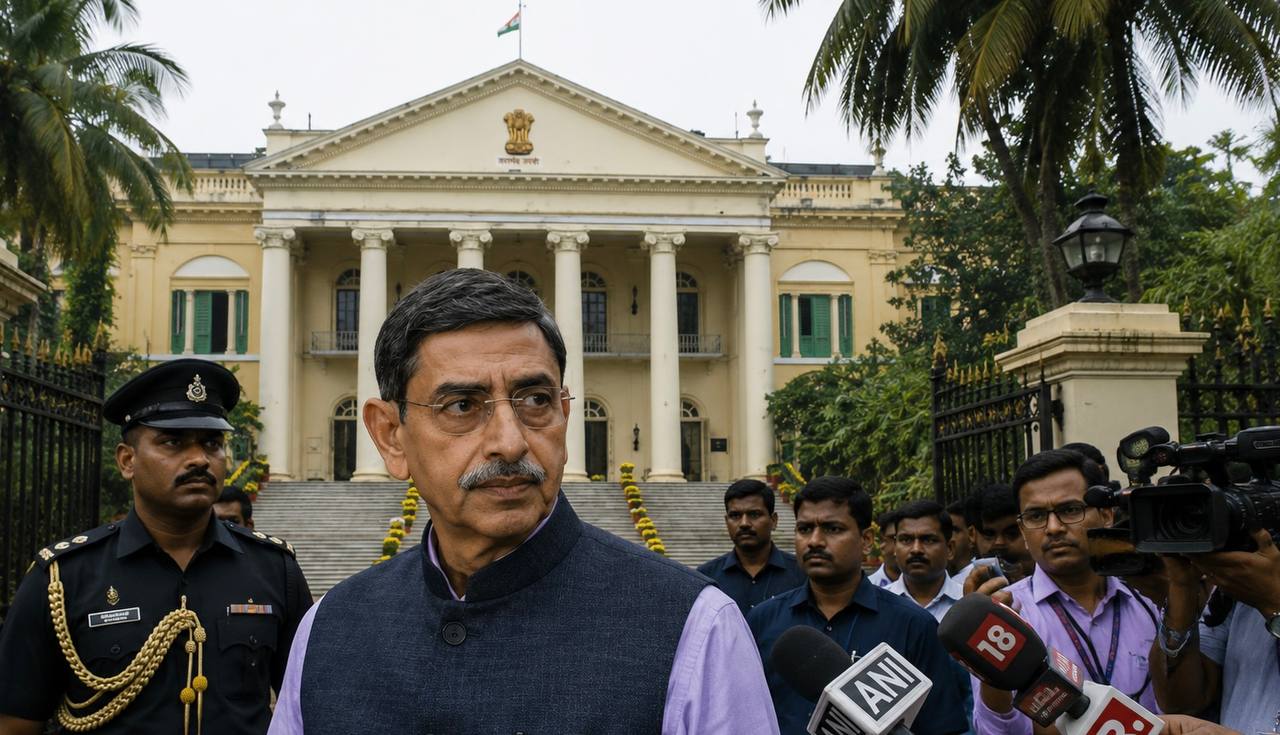

West Bengal Governor R.N. Ravi dissolved the state’s 294-seat Legislative Assembly on 07 May 2026, following the completion of its five-year term and the conclusion of state elections. The development came amid reports that Chief Minister Mamata Banerjee had initially refused to resign, with the Trinamool Congress signalling a legal challenge.
The Dissolution Order
Governor R.N. Ravi signed the dissolution order on 07 May 2026 upon the expiry of the Assembly’s five-year constitutional term and in the wake of recently concluded state elections. Ravi, who replaced former Governor C.V. Ananda Bose following Bose’s resignation in early March 2026, acted in his capacity as constitutional head of the state.
The dissolution is procedural in nature, distinct from an Article 356 President’s Rule action. No constitutional breakdown report was forwarded to the Ministry of Home Affairs.
“The elected government of West Bengal retains the mandate of the people. The Chief Minister will not resign on the basis of any extra-constitutional directive.”
Chief Minister's Office, West Bengal · CMO Statement · 07 May 2026
Banerjee’s Position
Mamata Banerjee, who leads the All India Trinamool Congress, contested the basis of any resignation directive, arguing that an elected Chief Minister can only be removed through a floor test or judicial process. Her legal team cited the Supreme Court’s ruling in S.R. Bommai vs Union of India (1994), which established that a floor test — not a Governor’s unilateral judgement — is the constitutionally valid method to determine majority support.
The Bommai ruling held that any attempt to remove an elected government without a prior floor test is subject to Supreme Court review and can be struck down.
The Trinamool Congress said it was prepared to move the Supreme Court within 24 hours if any unconstitutional pressure on the Chief Minister continued.
Ground Impact Across West Bengal
With the Assembly dissolved, all legislative business in West Bengal halts. The state budget process stalls immediately. Across all 23 districts — including Kolkata, Howrah, and North 24 Parganas — administrative continuity depends on the formation of a new government following fresh elections.
ℹ️ Article 356 — Key Facts
- Article 356 empowers the President to assume state governance when constitutional machinery fails.
- A Governor’s report is a prerequisite but does not automatically bind the President.
- The S.R. Bommai (1994) ruling made President’s Rule subject to judicial scrutiny.
- Parliament must ratify any President’s Rule proclamation within 2 months.
- The Election Commission of India must schedule fresh Assembly elections within 6 months of dissolution.
What Happens Next
The Election Commission of India must schedule fresh Assembly elections for West Bengal within 6 months of the 07 May 2026 dissolution. Any Supreme Court petition by the Trinamool Congress is expected by 08 May 2026. The outcome of that filing — and whether a new government can be sworn in — will determine if Bengal faces a prolonged period without an elected Assembly.
FAQ
Why was the Bengal Assembly dissolved?
Who is West Bengal's current Governor?
When must fresh elections be held?


