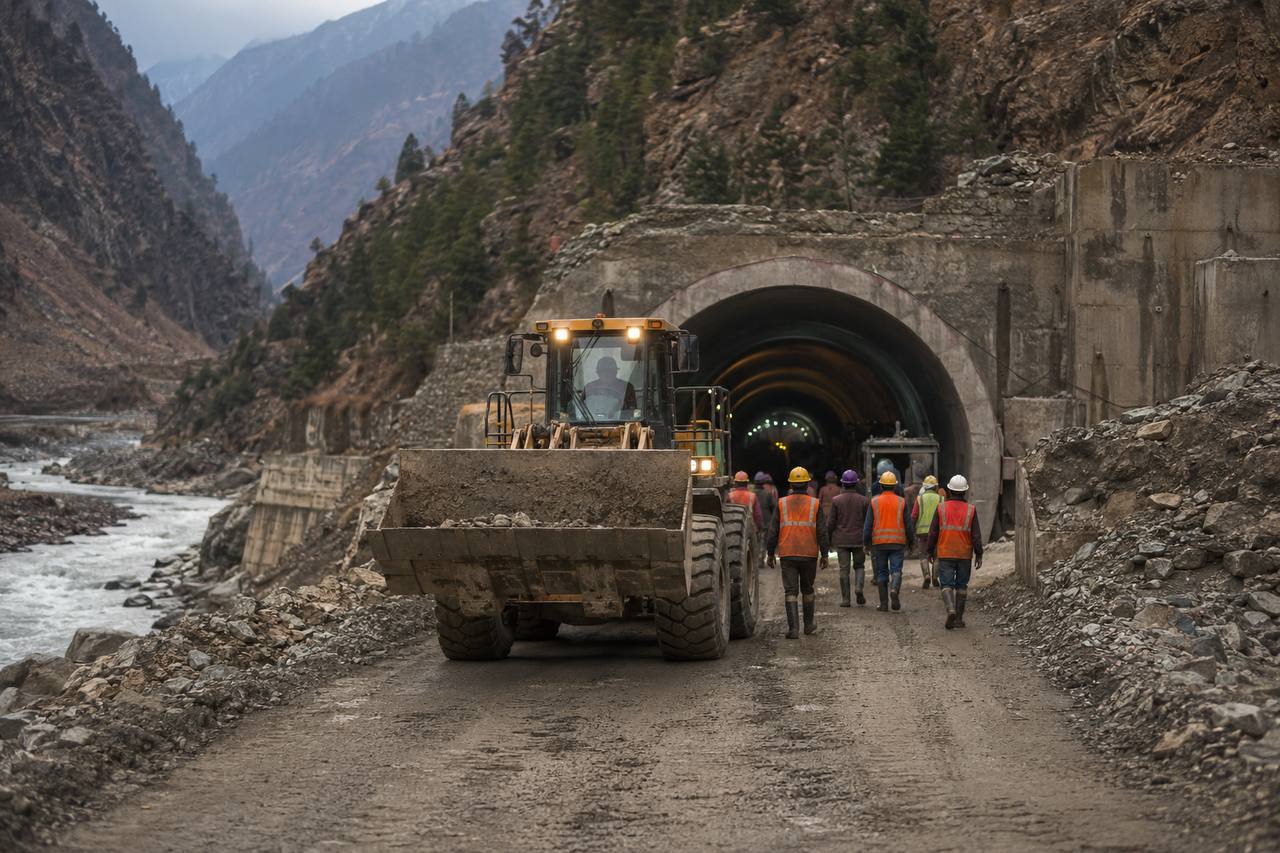

In a significant push to optimise its Himalayan water resources, the Indian government has set a July 2029 completion target for the ambitious Chenab-Beas Link Tunnel Project in Himachal Pradesh’s Lahaul-Spiti district. Work on the ground is expected to begin as early as August 2026. Led by the National Hydroelectric Power Corporation (NHPC), this ₹2,352 crore initiative marks a concrete step in India’s strategy to better utilise waters from the western rivers, even as the 1960 Indus Waters Treaty remains in abeyance.
Project Details
The core of the project is an 8.7-km underground tunnel that will divert surplus monsoon and snow-melt flows from the Chandra River — one of the two main tributaries that form the Chenab (also known as Chandrabhaga) — into the upper Beas River basin. A 19-metre-high barrage near Koksar village, upstream of the Atal Tunnel’s north portal, will help regulate the flow in the initial phase. The diverted water will feed into the Beas system, ultimately supporting the existing Sutlej-Beas network and major reservoirs like Bhakra.
This is not a standalone effort. It pairs with a sediment-bypass tunnel at the Salal Dam in Jammu & Kashmir. Together, these recent Chenab-related initiatives reflect a combined investment of around ₹2,600 crore. Officials highlight the project’s potential to unlock additional hydropower capacity — possibly several thousand megawatts in the region through linked infrastructure — while improving water availability across Himachal Pradesh, Punjab, Haryana, Rajasthan, and parts of Delhi.
The engineering challenges are formidable: high-altitude Himalayan terrain, fragile geology, extreme weather, and ecological sensitivity. Yet the aggressive timeline reflects New Delhi’s determination to move forward with greater speed than in previous decades.
Strategic Impact and Treaty Context
Under the original Indus Waters Treaty, India received unrestricted rights over the eastern rivers (Ravi, Beas, and Sutlej), while Pakistan was allocated the western rivers (Indus, Jhelum, Chenab). India was permitted only limited non-consumptive uses such as run-of-the-river hydropower and restricted storage on the western rivers. For decades, New Delhi developed projects cautiously to remain within treaty bounds.
Following the 2025 Pahalgam terror attack, India placed the treaty in abeyance until Pakistan takes credible and irreversible action against cross-border terrorism. This suspension has removed many earlier political and diplomatic constraints, allowing faster pursuit of storage, sediment management, and inter-basin transfers. The Chenab-Beas link fits squarely into this new approach: it channels surplus water that would otherwise flow downstream, converting potential into tangible domestic benefits.
Strategically, the project strengthens India’s control over upper catchment flows, enhances flood moderation capabilities, boosts renewable energy output for northern grids, and builds long-term resilience against climate variability and changing rainfall patterns. It also signals a clear policy shift — water infrastructure decisions will now prioritise India’s developmental and security needs more assertively.
Impact on Pakistan
Pakistan has reacted with concern to these developments, viewing any reduction in flows as a threat to its agriculture-dependent economy. The Chenab supplies critical water to Pakistani canal systems, supporting millions of hectares of farmland and several hydropower stations. Even modest diversions could add pressure on downstream headworks, particularly during lean seasons, compounding existing challenges such as groundwater depletion, siltation, and climate-induced variability.
That said, the scale of this specific diversion is relatively limited compared to the overall volume of the Chenab. It is unlikely to cause immediate catastrophic shortages but will contribute to incremental stress over time. Pakistan has raised diplomatic objections and highlighted potential humanitarian consequences, yet its ability to influence outcomes remains constrained amid broader bilateral tensions.
Benefits to Indian Farmers
For Indian agriculture, the gains, though indirect, are meaningful. Additional flows into the Beas will augment storage in Bhakra and connected reservoirs, helping stabilise supplies for the vast irrigated areas of Punjab, Haryana, and Rajasthan. This support is valuable for both rabi and kharif crops in regions that frequently face water stress. It reduces over-dependence on erratic monsoons and depleting groundwater, while potentially easing interstate water-sharing disputes by increasing overall availability in the basin.
Himachal Pradesh stands to gain from local hydropower development and possible irrigation benefits in valley areas. Downstream states will see improved reliability of supplies. In a country where agriculture remains a major source of livelihood and food security is a national priority, even incremental increases in assured water can translate into higher yields, lower drought vulnerability, and better support for efforts to raise farmer incomes.
Analysis: Trade-offs and the Road Ahead
This project represents a pragmatic reorientation of India’s water policy — moving from long-standing treaty-bound restraint toward fuller sovereign optimisation of its allocated resources. It aligns with older river-linking concepts while addressing urgent needs for energy transition and climate resilience through hydropower and storage.
Challenges remain significant. Environmental experts have flagged risks to Lahaul’s fragile high-altitude ecosystem, glaciers, and biodiversity. Local communities seek fair compensation and benefit-sharing. Technical risks inherent in high-altitude tunnelling — geology surprises, avalanches, and cost overruns — cannot be ignored, as past Himalayan projects have shown.
Diplomatically, while the treaty’s abeyance provides operational space, sustained international attention and Pakistan’s objections could complicate future expansions. India will need to balance assertive utilisation with transparent data-sharing and strong environmental safeguards to retain credibility.
Ultimately, the Chenab-Beas link is more than an infrastructure project. It is a statement of strategic intent in an era of growing water scarcity and geopolitical friction. Success will hinge not only on meeting the 2029 deadline but also on equitable distribution of benefits within India and responsible long-term management of shared river systems. For millions of farmers across northern India, it offers hope of more reliable water; for regional stability, it highlights the continuing need for pragmatic engagement even amid deep disagreements.