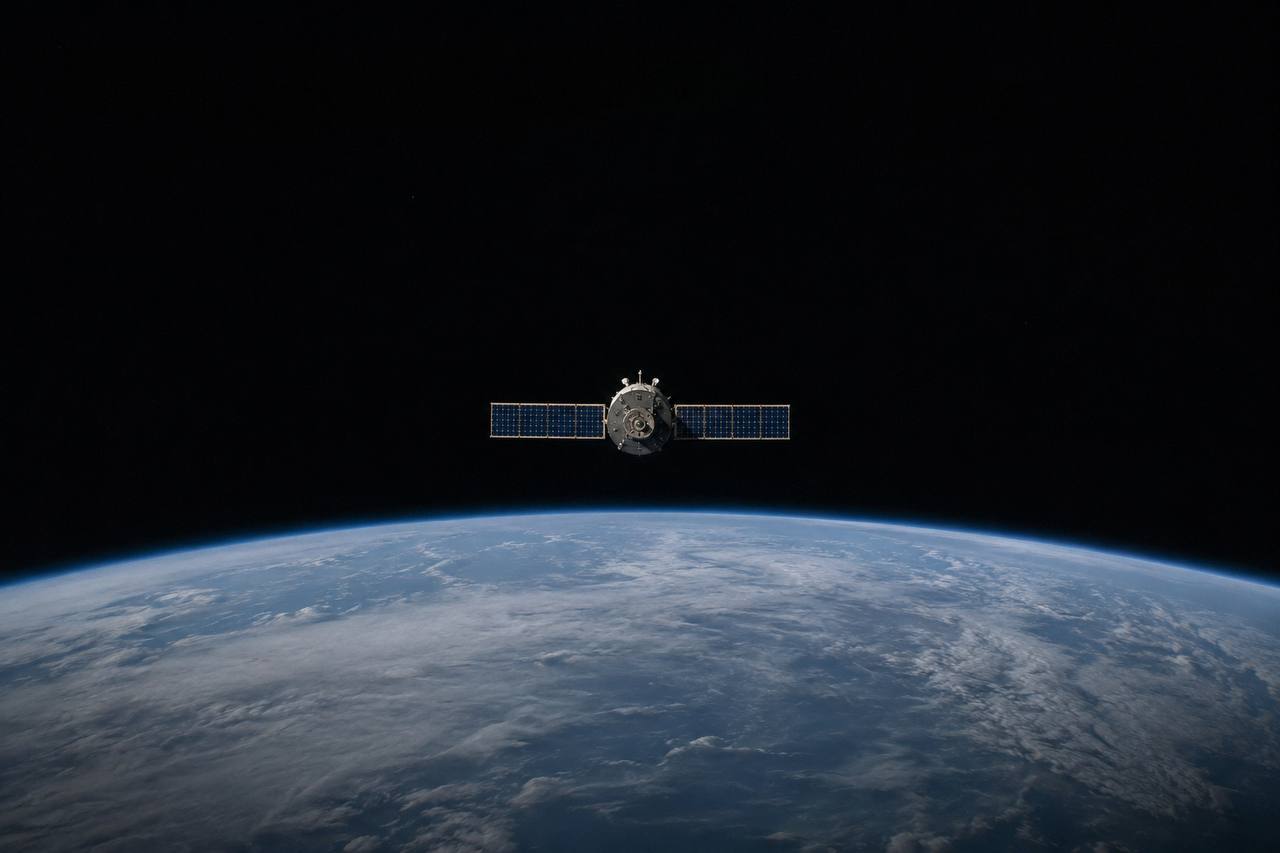

Carbon dioxide is cooling the thermosphere — the atmospheric layer from 80 km to 600 km above Earth — at roughly 1°C per decade, reducing the natural drag that pulls space debris out of orbit and raising collision risk for more than 9,000 active satellites.
Opposite Physics, Same Cause
At ground level, CO2 traps outgoing infrared radiation and warms the surface — up approximately 1.42°C to 1.46°C since pre-industrial levels in 2024/2025. In the thermosphere, the physics reverse: air is too thin to reabsorb radiated heat, so CO2 molecules shed energy directly into space. The layer cools and contracts.
Contraction is the operational problem. A thinner thermosphere exerts less aerodynamic drag on orbiting objects. Drag is what decelerates debris and draws it back toward Earth. At roughly 400 km — the orbit shared by the International Space Station and most commercial low-Earth-orbit satellites — atmospheric density, and thus drag, is projected to decrease by 50–66% by 2100, implying a drag reduction rate far exceeding the currently observed ~2% per decade and stretching a five-year debris lifetime to six or seven years even now.
CO2 Effect by Atmospheric Layer
CO2 traps infrared radiation, raising surface temperatures approximately 1.42°C–1.46°C since pre-industrial levels
CO2 radiates heat to space, cooling the layer ~1°C per decade and driving a projected 50–66% drop in orbital density by 2100
A Congested Orbit Getting More Dangerous
SpaceX’s Starlink constellation exceeds 10,000 active satellites as of May 2026. Amazon’s Project Kuiper began launches in 2025. Every percentage-point drop in drag meaningfully extends the time debris lingers among operational hardware.
GPS and communication signals are also affected. A contracted upper atmosphere alters signal propagation paths, introducing positioning errors that ground stations must correct continuously. Scientists modelled thermospheric CO2 cooling in the 1990s, but the rate has accelerated as atmospheric CO2 crossed 425 parts per million in 2024 — a concentration unseen in at least 800,000 years.
India’s Operational Exposure
The Indian Space Research Organisation (ISRO) operates NavIC, a regional navigation system designed with seven satellites. As of March 2026, only three of these satellites were fully operational for providing position, velocity, and timing services — below the minimum required for accurate position data. NavIC underpins train collision-avoidance on Indian Railways and fishing-vessel tracking across Tamil Nadu, Gujarat, and Kerala. Both applications rely on upper-atmospheric density models; as the thermosphere contracts unevenly, those models need recalibration to maintain accuracy.
ISRO’s Space Situational Awareness Control Centre in Bengaluru tracks around 22,000 orbital objects. Reduced natural debris clearance adds directly to the computational load of predicting close approaches between active satellites and junk — events the agency must flag and, where possible, manoeuvre around.
The June 2026 Decision Point
The United Nations Office for Outer Space Affairs will review updated space debris mitigation guidelines at its Committee on the Peaceful Uses of Outer Space session in Vienna in June 2026. Researchers are pressing for thermospheric cooling trends to be formally incorporated into debris-lifetime calculations used by national space agencies — ISRO included — before the end of 2026. Without that adjustment, debris-clearance timelines embedded in current orbital-safety frameworks are systematically optimistic.
⚖️
Verdict: Orbital Safety Urgency
CO2-driven thermospheric cooling reduces the natural drag that clears debris, requiring updated satellite density models and tighter international guidelines before orbit congestion reaches a threshold that active manoeuvring alone cannot manage.