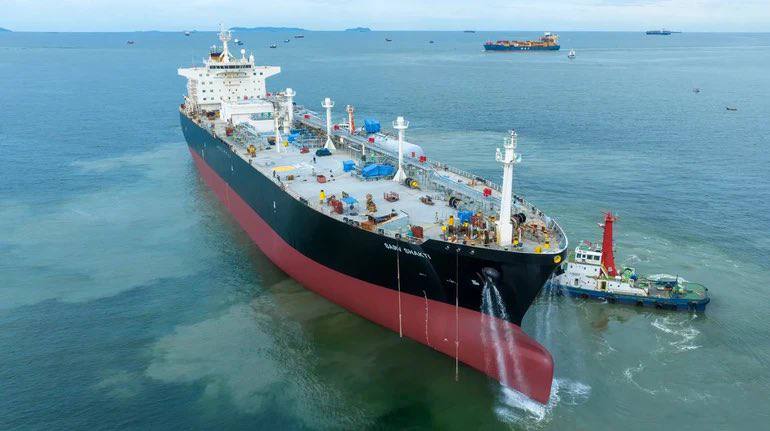

The Marshall Islands-flagged supertanker Sarv Shakti, carrying 45,000 tons of liquefied petroleum gas bought by state-run Indian Oil Corporation (IOC), transited the Strait of Hormuz on Saturday, becoming the first India-linked tanker observed exiting the chokepoint since the United States intensified its blockade on Iran-tied shipping.
Ship-tracking data showed the very large gas carrier moving northward past Iran’s Larak and Qeshm islands toward the Gulf of Oman. The vessel was broadcasting India as its destination and flagging its Indian crew on board, a safety protocol adopted by ships in the region since the Iran-US conflict began.
The cargo was loaded via ship-to-ship transfer off Dubai before the Sarv Shakti began the transit. IOC, listed as the buyer on shipping documents seen by Bloomberg, did not respond to a request for comment.
The cargo equals roughly half a day of India’s pre-war LPG consumption, according to Indian Express. India is the world’s third-largest LPG consumer and depends heavily on West Asian supply for cooking fuel sold under the Pradhan Mantri Ujjwala Yojana (PMUY) network.
Two weeks of near-zero traffic
The last major India-bound energy tanker to cross was the crude carrier Desh Garima on April 18, after Iran briefly announced free passage through the Strait. Tehran reversed the decision within hours. On the same day, Iranian forces fired on two Indian-flagged vessels, forcing them and other India-bound ships to retreat into the Persian Gulf.
Parallel blockades — one enforced by Iran, another by the United States targeting Iran-tied shipping — pushed Hormuz transits close to zero. The Sarv Shakti is among the largest carriers to attempt the outbound crossing since that chaotic weekend.
ℹ️ Why Hormuz matters for India
- Approximately 80-90% of India’s LPG imports and 40-50% of crude oil imports typically cross the Strait of Hormuz.
- India has separately negotiated bilateral clearance for 8 LPG vessels through direct talks with Tehran.
- IOC, Bharat Petroleum Corporation Limited (BPCL) and Hindustan Petroleum Corporation Limited (HPCL) distribute imported LPG through 32.8 crore active domestic connections.
What’s next
Once clear of the Gulf of Oman, the Sarv Shakti is expected to head to an Indian west-coast port, though IOC has not confirmed the discharge terminal. The Ministry of Petroleum and Natural Gas has consistently denied any fuel shortage or rationing of petrol, diesel or LPG, dismissing such reports as misinformation. The Ministry’s last public statement on March 26, 2026 confirmed supplies were secure with no rationing at any outlet.
Traders are watching whether more India-bound carriers attempt the same route in the coming week, with at least three additional LPG vessels reportedly waiting in the Persian Gulf for safe-passage clearance from both Washington and Tehran.
FAQ
What is Sarv Shakti carrying?
Why is this transit significant?
When did the last India-bound energy tanker cross?