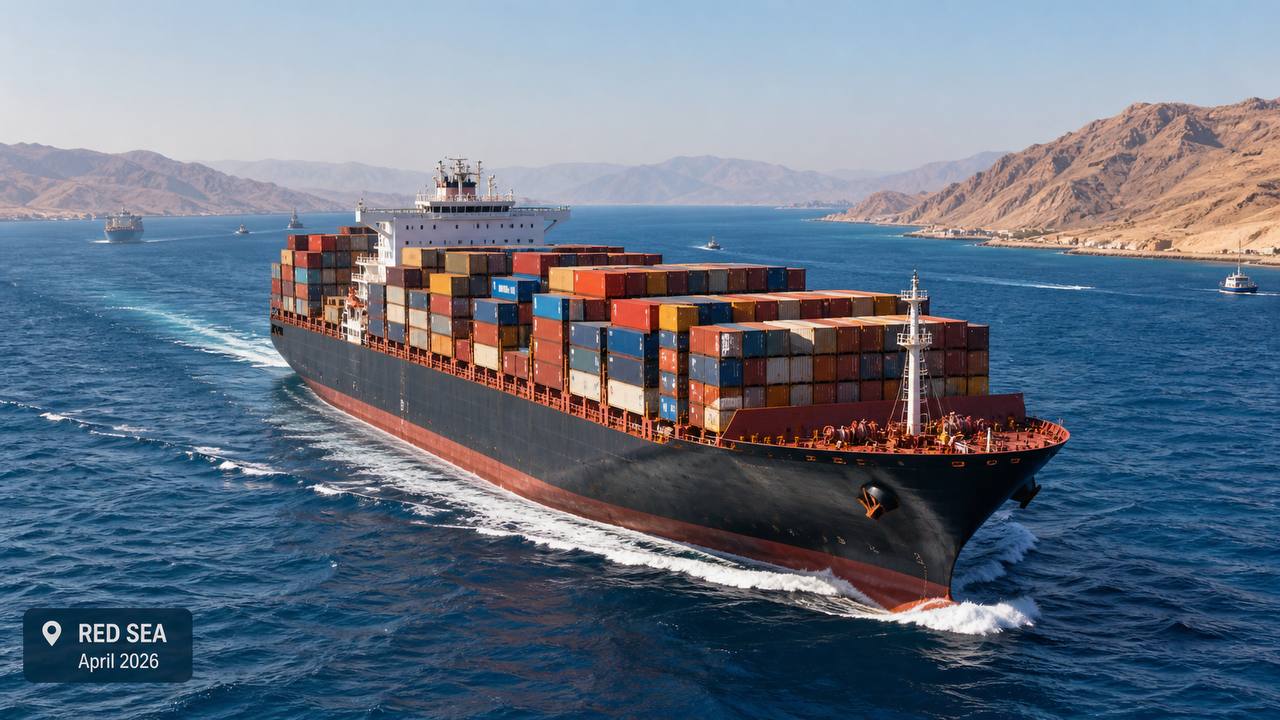

Firozabad’s ₹10,000 crore glass industry — which produces 70% of India’s glass bangle output — recorded a 25–30% fall in export orders from early 2024 after Houthi attacks on Red Sea shipping forced a global reroute, tripling freight costs overnight. As of May 2026, the disruption has outlasted most industry forecasts, and order recovery remains incomplete.
Houthi militants began targeting commercial vessels in the Red Sea in late 2023. Maersk data shows 90% of container ships on the Europe–Asia corridor rerouted via the Cape of Good Hope from December 2023, adding 10–14 days per voyage and $500–$800 per container above standard Red Sea rates. The Suez Canal corridor handles roughly 30% of India’s containerised exports to Europe and the United States.
The All India Glass Manufacturers’ Association (AIIGMA) reported to the Ministry of Commerce and Industry in 2024 that Firozabad’s furnace capacity utilisation had dropped 15%. Running furnaces below optimal load raises per-unit costs, cutting into the thin margins on which export contracts are priced. Europe and the US together absorb 60% of the district’s output.
“Buyers in Germany and the UK cancelled forward orders or shifted to Chinese suppliers. Without a freight subsidy or a government logistics window, we cannot hold these contracts.”
AIIGMA Spokesperson · All India Glass Manufacturers' Association · April 2024
The Federation of Indian Export Organisations (FIEO) warned the Uttar Pradesh Export Promotion Council in 2024 that 50,000 daily-wage artisans in Firozabad faced job losses if the Red Sea disruption extended beyond Q3 2024. None of these workers holds a formal employment safety net. Tirupur garments and Ludhiana hosiery filed parallel alerts with FIEO, confirming the damage spans India’s labour-intensive export clusters.
The Ministry of Commerce launched discussions with major shipping lines on freight relief in 2024 and mapped multimodal alternatives — including rail-to-port corridors through the Middle East. A freight support package was expected by June 2024. MEA did not respond by publication time on whether diplomatic channels remain active with shipping flag states as of May 2026.
ℹ️ Why the Red Sea Route Matters for India
- The Suez Canal–Red Sea corridor carries roughly 30% of India’s containerised exports to Europe and the US.
- Firozabad supplies an estimated 70% of India’s total glass bangle output.
- The Cape of Good Hope detour added $500–$800 per container above standard Red Sea rates at the 2024 peak, per Maersk.
- The International Maritime Organization has not declared a formal safe-passage protocol for the corridor as of publication date.
AIIGMA has indicated it will petition the Prime Minister’s Office if freight conditions and order volumes do not return to pre-crisis levels before the end of Q2 2026. The association represents Firozabad’s 2.5 lakh-strong workforce and is seeking a formal government review of export cluster support by July 2026.
FAQ
Why are Houthi attacks affecting Indian exports?
Which Indian industries are most exposed?
What relief has the government provided so far?


