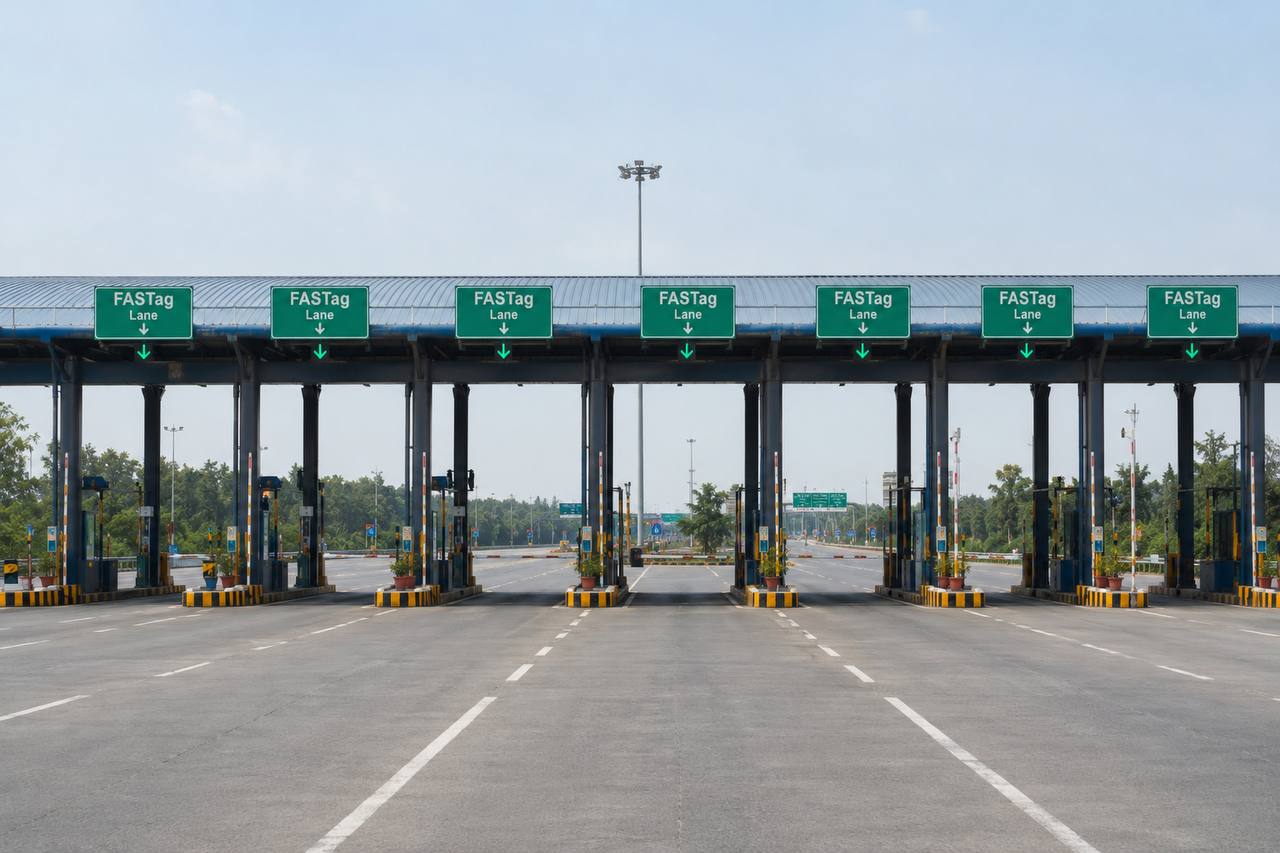

The National Highways Authority of India (NHAI) activated the Multi-Lane Free Flow (MLFF) barrier-less tolling system at the Mundka-Bakkarwala Toll Plaza on Delhi’s Urban Extension Road-II (UER-II) on 11 May 2026 — making it the first barrier-free toll plaza in the Delhi-NCR region.
How It Works
Automatic Number Plate Recognition (ANPR) cameras at each lane read a vehicle’s number plate at highway speeds and match it to the linked FASTag wallet, deducting the toll without the vehicle stopping. The mechanical barrier cycle — which took roughly 14 seconds per vehicle in conventional FASTag lanes — is eliminated entirely. NHAI’s centralised back-end reconciles wallet balances in real time, flagging low-balance or blacklisted tags for downstream enforcement rather than holding up traffic at the lane.
Who Gains Most
Freight operators running daily Delhi-NCR routes stand to benefit most. Commercial vehicles pay higher toll rates and make multiple corridor crossings per day. NHAI pilot data shows barrier removal at high-volume plazas can cut average per-vehicle wait time by over 80 percent during peak hours. Reduced idling lowers fuel burn per trip — a direct cost saving for fleet operators.
Private commuters on UER-II — a high-density corridor connecting west Delhi to the Outer Ring Road — gain uninterrupted flow without any hardware change. Any valid, funded FASTag linked to a registered number plate works automatically at barrier-free lanes.
ℹ️ Why MLFF Is Different From Standard FASTag
- Conventional boom barriers create stop-and-go queues even for FASTag users — the gate must physically cycle open and shut per vehicle.
- ANPR-only lanes compress per-vehicle plaza time from roughly 14 seconds to under 2 seconds, based on NHAI pilot data from earlier NH corridor trials.
- Enforcement moves off-lane: number plate capture creates an automatic record for post-facto recovery, removing the bottleneck of on-the-spot penalty collection.
Non-FASTag Vehicles
Vehicles without a valid, funded FASTag remain liable under Ministry of Road Transport and Highways (MoRTH) rules already in national force: double the applicable toll rate. ANPR capture of the number plate creates an enforceable record. Repeat offenders can be referred to enforcement agencies. No exemptions apply at the newly activated Mundka-Bakkarwala plaza.
“The barrier-free system is designed to ensure seamless, contactless toll collection while maintaining full revenue integrity through ANPR-based enforcement.”
NHAI · PIB Press Release · 11 May 2026
What Comes Next
The Mundka-Bakkarwala launch is the opening move in a formally notified national rollout. Phase one covers 17 toll plazas across nine states — including Delhi and Haryana — with MLFF adoption targeted by September 2026. A second phase adds over 108 toll plazas, with completion set for March 2027. NHAI is expected to publish a plaza-level coverage map on its official portal as each location goes live.
FAQ
Do I need a new FASTag for the barrier-free plaza?
What if my FASTag balance is zero at a barrier-free plaza?
Which plaza is live first, and when do more follow?