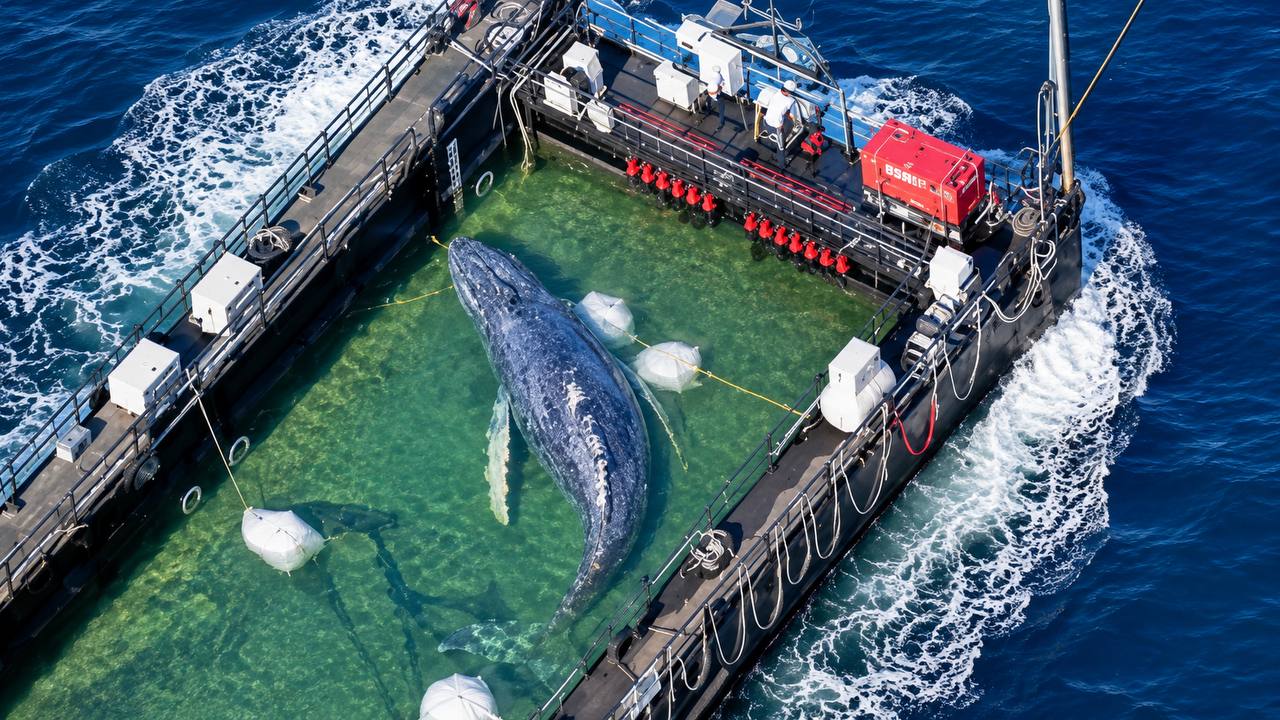

A humpback whale nicknamed ‘Timmy’ was released into the North Sea on Saturday, May 2, 2026, after a privately funded German rescue operation transported the animal via a flooded barge from Germany’s Baltic Sea coast, where it had been stranded for weeks.
Videos of the operation spread rapidly on X, accumulating over 14 million views in 48 hours. The hashtag #SaveTimmy trended at #2 in the UK and #7 globally, with 320,000 posts logged across X and Instagram combined.
The rescue method — a flooded barge used to lift and transport the whale — reflected the hard limits of humpback intervention. Humpbacks can weigh up to 30 tonnes, and British Divers Marine Life Rescue (BDMLR) confirmed its refloatation pontoons were unsuitable for an animal of that size. Physical intervention at scale requires specialist equipment most marine rescue organisations do not carry.
A Rescue That May Have Failed
The optimism surrounding Timmy’s release did not last. A GPS transmitter was attached before the whale entered open water, but its functionality was later questioned. The German Oceanographic Museum said it believed Timmy was highly likely dead — a sobering coda to an operation that had united millions of viewers across platforms.
Naming a stranded animal reliably amplifies public response, and rescue organisations now factor that dynamic into their communications strategy, using viral attention to drive funding and policy traction. When a sperm whale entered the Thames in January 2006, coverage triggered emergency government briefings. ‘Benny’ the beluga in the Seine in 2022 drew French television crews for six days and prompted a formal inter-ministerial coordination call. Benny also died. The emotional arc — mass public investment followed by likely loss — is becoming a recurring feature of high-profile cetacean rescues, raising questions about whether viral momentum distorts operational decision-making or simply funds it.
Why Strandings Are Rising
Warming North Sea and Baltic waters are pushing prey species closer to shore, drawing cetaceans into unfamiliar shallows with greater frequency. Timmy’s stranding fits that pattern. BDMLR has recorded a marked rise in public-reported strandings over the past decade across UK coastal waters.
India Connection
The Whale and Dolphin Conservation India network shared footage of the Timmy operation, drawing comparisons to the Tamil Nadu coast at Manapad in 2016, when over 80 pilot whales beached across 72 hours — one of the largest mass strandings recorded in Indian waters. Marine biologists tracking the Arabian Sea and Bay of Bengal have cited warming pressures analogous to those affecting the Baltic and North Sea.
What Happens Next
With the GPS transmitter’s reliability in doubt and no confirmed sighting since release, the German Oceanographic Museum’s assessment that Timmy likely did not survive may stand as the final word. Whether the privately funded operation will publish a formal debrief — and whether its findings feed into broader EU stranding-response protocols — remains to be seen in the weeks ahead.
