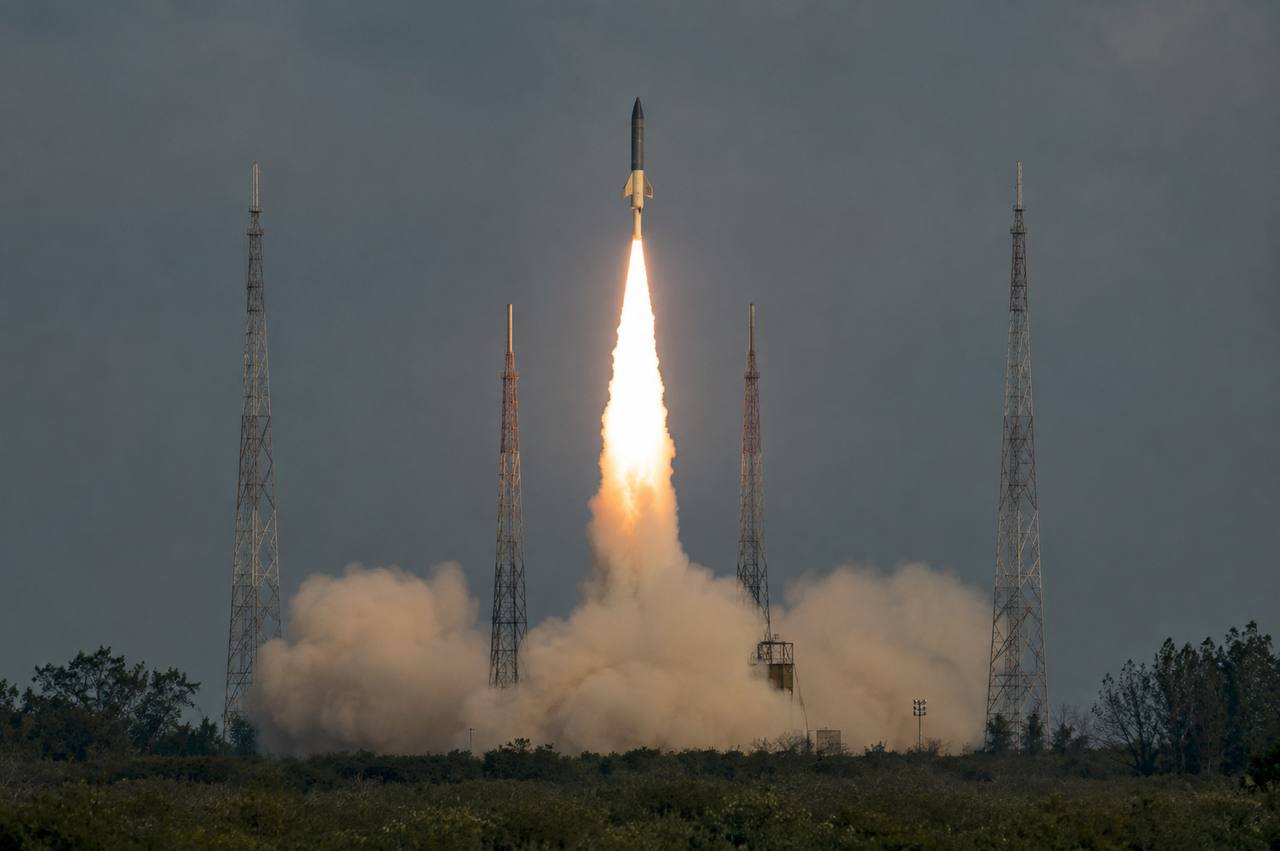

The successful test-firing of the Suryastra Universal Rocket Launcher System by Pune-based Nibe Limited on May 18 and 19, 2026, at the Integrated Test Range in Chandipur, Odisha, marks a watershed moment in India’s military-industrial trajectory. Achieving a Circular Error Probable (CEP) of 1.5 metres at 150 kilometres, and a sub-2-metre CEP at 300 kilometres, the trials set a new benchmark for indigenous private-sector defence manufacturing. Executed under a ₹293 crore Emergency Procurement (EP) contract for the Indian Army, this demonstration extends far beyond a routine capability test; it signals a structural shift in how India develops, procures, and deploys deep-strike artillery.
For decades, India’s defence production has been monopolised by Defence Public Sector Undertakings (DPSUs) and Ordnance Factories. Today, private participation accounts for approximately 23 per cent of total defence manufacturing. The Suryastra milestone serves as the ultimate proof of concept for the Atmanirbhar Bharat (Self-Reliant India) initiative, demonstrating that the private sector is no longer confined to component manufacturing, but is now capable of delivering complete, highly complex weapon systems.
The Suryastra Paradigm: Bridging the Range-Precision Gap
To understand the operational significance of the Suryastra, one must examine the current composition of the Indian Army’s artillery profile. Historically, the military has relied on the indigenous Pinaka multi-barrel rocket launcher (MBRL) and the Russian-origin BM-30 Smerch for area-saturation missions. While the Pinaka has seen its range incrementally upgraded to the 90–120 kilometre bracket, these systems were fundamentally designed to deliver massive suppressive fire over a grid square, rather than surgical strikes against specific hard targets.
The Suryastra, developed through a July 2025 Technology Collaboration Agreement with Israel’s Elbit Systems and based on the proven Precise & Universal Launching System (PULS), alters this tactical geometry. By delivering a 2-metre CEP at 300 kilometres, it bridges a critical capability gap. Previously, neutralising high-value targets (HVTs)—such as adversary command posts, air defence radars, or ammunition dumps deep in hostile territory—required tasking expensive and limited-inventory ballistic or cruise missiles, like the BrahMos. Suryastra democratises the deep strike, offering commanders a cost-effective, high-precision alternative that preserves strategic missile inventories for strategic targets.
Furthermore, the system’s modular, multi-calibre architecture allows a single platform to fire varying rocket types, precision-guided munitions (PGMs), and loitering munitions. Mounted on high-mobility vehicular platforms, it is inherently designed for rapid “shoot-and-scoot” operations, a non-negotiable requirement for survivability against modern counter-battery radars and drone swarms.
The Vanguard of Private Defence Industrialisation
Nibe Limited’s rapid execution of the Suryastra contract is symptomatic of a much broader resurgence across India’s private defence ecosystem. Empowered by systemic reforms—such as updates to the Defence Acquisition Procedure (DAP) and the gradual opening of ammunition and missile integration to non-state actors—private conglomerates are aggressively expanding their military portfolios.
Kalyani Strategic Systems: The Metallurgical Edge
The Bharat Forge/Kalyani Group has systematically positioned itself as a global powerhouse in heavy artillery. Their flagship achievement, the Advanced Towed Artillery Gun System (ATAGS)—a 155mm/52-calibre howitzer co-developed with the Defence Research and Development Organisation (DRDO)—outperforms legacy systems in both range and accuracy. Kalyani’s distinct advantage lies in its foundational expertise in metallurgy and heavy forging, allowing it to manufacture gun barrels that withstand higher chamber pressures for extended ranges. The group has already secured export orders for over 100 artillery guns to European and allied markets, proving that Indian heavy engineering can compete globally. With a pipeline expanding into ultra-light howitzers, mounted gun systems, and smart recoil technologies, Kalyani is primed to capture the lion’s share of the Army’s requirement to replace its ageing artillery inventory with indigenous 155mm platforms.
Larsen & Toubro and Tata Advanced Systems: The Integration Heavyweights
Larsen & Toubro (L&T) and Tata Advanced Systems Ltd (TASL) have transitioned from being tier-one suppliers to prime system integrators. Both are pivotal production partners for the Pinaka MBRL, handling launcher manufacturing, pod integration, and command system upgrades. L&T’s successful delivery of the K9 Vajra self-propelled howitzer and its critical involvement in the Akash air defence system and naval platform manufacturing demonstrate a mature capacity for complex systems integration. TASL, having achieved nearly 80 per cent indigenous content in specific Pinaka components, is actively expanding into broader missile lifecycle support. Their proven ability to scale production reliably provides the Ministry of Defence (MoD) with the confidence to issue larger, multi-year procurement contracts.
Adani Defence & Aerospace: The Conglomerate Approach
Operating with immense capital expenditure, Adani Defence has established one of South Asia’s largest integrated ammunition and missile complexes. Their strategic focus is distinctly futuristic, aggressively targeting the unmanned aerial vehicle (UAV) segment, counter-drone architectures, and loitering munitions. By forming joint ventures for 70mm rockets and advanced sonobuoy technologies, Adani is building a vertically integrated supply chain. Their investments in AI-enabled, multi-domain systems and dedicated facilities for warhead integration indicate a strategy aimed at dominating the high-volume, high-consumability munitions market, which has gained acute relevance following the lessons of recent European conflicts.
The Specialised Innovators
The ecosystem is further bolstered by mid-sized firms and startups. Companies like Solar Industries and Economic Explosives Ltd (EEL) have successfully absorbed DRDO technology transfers for Pinaka rocket production, breaking the DPSU monopoly on propellants and energetics. Concurrently, a vibrant layer of startups—often incubated under the Innovations for Defence Excellence (iDEX) scheme—is filling critical technological niches in sensor development, miniaturised guidance kits, and drone swarm algorithms.
Policy Enablers and the Strategic Pipeline
The current momentum is underpinned by aggressive policy scaffolding. The MoD’s decision to open the manufacturing of 105mm, 130mm, and 150mm artillery shells, along with various aerial bombs and munitions, to the private sector has created a lucrative domestic market.
More consequential are the advanced discussions expected to materialise in the forthcoming Defence Acquisition Procedure (DAP) 2026, which aims to permit private firms to manufacture ballistic missiles. This domain has been fiercely guarded by DRDO and state-owned entities for decades. Opening it to private industry signals a mature understanding in New Delhi that generating wartime “surge capacity” requires multiple, distributed manufacturing nodes that only the private sector can efficiently maintain.
India has set ambitious targets: ₹3 lakh crore in annual defence production and ₹50,000 crore in defence exports by 2029. Private firms are the primary engines for this growth. The export trajectory is already steeply upward, with Indian artillery, munitions, and radar systems finding ready buyers in Southeast Asia, the Middle East, and Eastern Europe. These firms are no longer just servicing domestic EP orders; they are actively integrating into the global supply chains of foreign prime contractors.
Operational Interdependence and Network-Centric Warfare
From a doctrinal perspective, the induction of systems like Suryastra fundamentally enhances India’s conventional deterrence, particularly along the contested Line of Actual Control (LAC) and the Line of Control (LoC). In a geopolitical theatre where adversaries are heavily investing in rocket forces and anti-access/area-denial (A2/AD) bubbles, fielding modular, long-range precision fires grants Indian strike corps enhanced operational depth and tactical flexibility.
However, a 300-kilometre rocket is only as effective as the intelligence guiding it. The true test of these new systems lies in their integration into the military’s broader C4ISR (Command, Control, Communications, Computers, Intelligence, Surveillance, and Reconnaissance) architecture. To fully leverage the Suryastra’s 2-metre CEP, the Army must ensure seamless data-link connectivity between frontline target acquisition assets (such as Heron Mk II drones, satellite imagery, and weapon-locating radars) and the launch batteries. The focus must now shift toward network-centric integration, ensuring that these advanced kinetic effectors are paired with equally advanced sensor networks.
Looming Bottlenecks: The Road to True Autonomy
Despite the highly visible successes, the structural challenges facing India’s private defence sector remain formidable.
- The Sub-Component Dependency: While platform integration is rapidly maturing, India remains heavily dependent on imports for critical sub-components. Advanced seekers (RF and imaging infrared), specialised alloys, military-grade semiconductors, and high-performance solid propellants are still largely sourced externally. True self-reliance will only be achieved when deep localisation of these foundational technologies occurs.
- Quality Assurance at Scale: Prototyping and limited-series production for emergency procurements are vastly different from sustaining high-quality, high-volume manufacturing over a decade. Private firms must establish rigorous, aerospace-grade quality control mechanisms to ensure that the 1,000th rocket fired performs exactly like the first.
- Public-Private Synergy: The narrative must not become a zero-sum game between DPSUs and the private sector. Long-term strategic programmes, such as nuclear-powered submarines or fifth-generation fighter aircraft, will still require the massive infrastructure and institutional memory of state-owned entities. The optimal model is one of deep collaboration, where DRDO focuses on fundamental R&D and private industry handles rapid commercialisation and mass production.
Nibe Limited’s successful trials of the Suryastra system are not an isolated triumph; they are the most recent dividend of a deliberate, decade-long policy pivot. India’s private defence industry has crossed the Rubicon, moving from assembling low-tech components to integrating highly lethal, precision-strike platforms.
As the geopolitical landscape grows increasingly volatile, the ability to manufacture precision munitions at scale domestically is no longer an economic luxury, but a supreme strategic imperative. With robust policy support, a willingness to absorb complex foreign technologies, and a clear demand signal from the armed forces, India’s private sector is rewriting the nation’s defence industrial narrative. The journey from chronic import dependence to becoming a net security provider and global arms exporter is fraught with technical and bureaucratic hurdles, but systems like the Suryastra prove that the trajectory is firmly, and irreversibly, set.