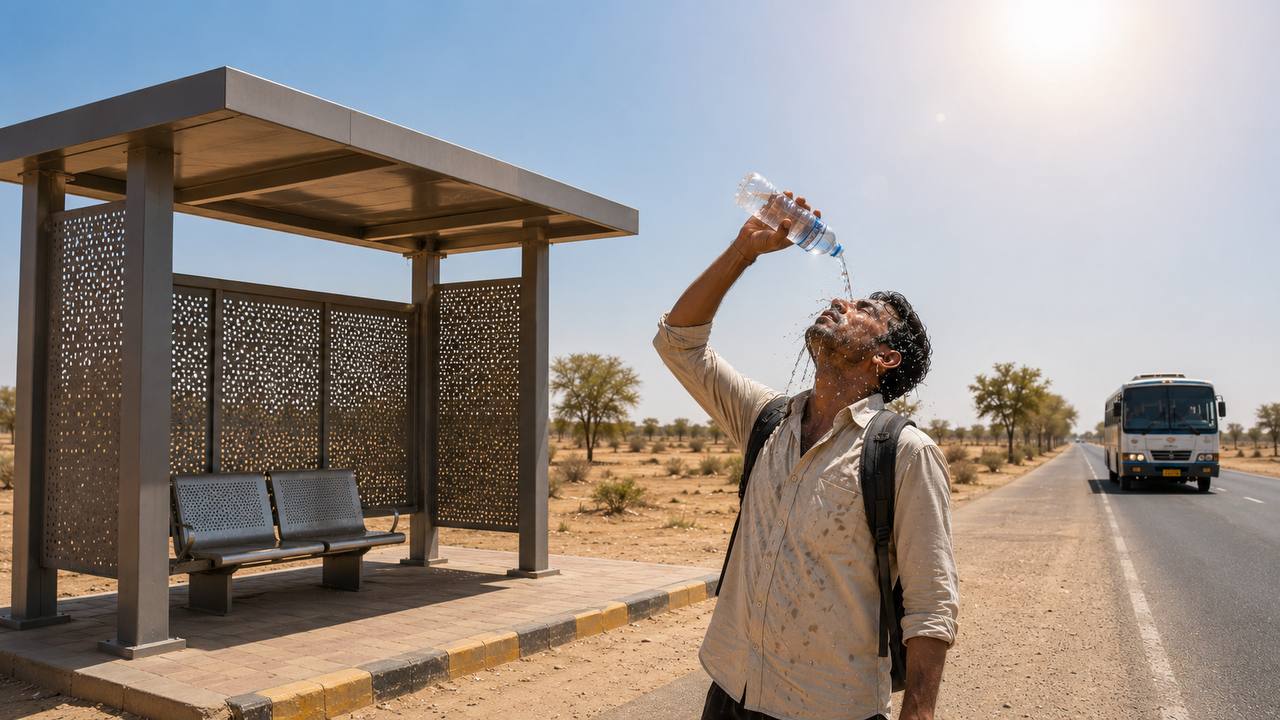

Temperatures have crossed 45°C in Rajasthan, Madhya Pradesh and Telangana this May, and the India Meteorological Department (IMD) has issued heatwave warnings for isolated pockets of West Rajasthan and Gujarat, with low probability of heatwave conditions in Rajasthan, Gujarat, Vidarbha, Madhya Pradesh and Uttar Pradesh forecast for the second week of May. Heat stroke — the most dangerous stage of heat illness — carries a fatality rate exceeding 50% without immediate intervention, according to the World Health Organization.
How the body fails
The body begins losing the fight at a core temperature of 37.5°C. At 40°C, organ stress sets in. At 41°C or above, the condition is heat stroke, and the primary cooling mechanism — sweating — breaks down entirely.
High humidity compounds the danger. Chennai or Mumbai at 38°C can be more physiologically threatening than Jaipur at 44°C because sweat cannot evaporate when air is already saturated with moisture.
Three stages, three responses
Heat cramps — painful muscle spasms in the legs or abdomen — are the first signal. Move to shade and drink an oral rehydration solution (ORS). Government ORS packets are available free through ASHA workers and sub-centres under the National Health Mission (NHM).
Heat exhaustion follows if cramps go unaddressed: heavy sweating, cold clammy skin, weak pulse, nausea and dizziness. The person is still sweating — that distinguishes it from heat stroke. Lay them flat, elevate their legs, apply cool wet cloths to the neck, armpits and groin, and give small sips of ORS every 15 minutes.
Heat stroke is the emergency. Sweating stops, skin turns hot and dry, and confusion or loss of consciousness follows. Call 112 immediately. Pack ice or cold wet towels around the neck, armpits and groin while waiting. Never give fluids orally to an unconscious person — the aspiration risk is serious.
Who faces the highest risk
ICMR’s 2023 Heat-Related Illness guidelines name five high-risk groups: adults over 65, children under five, outdoor labourers, people on diuretics or antihistamines, and those with chronic kidney or cardiovascular disease. Construction workers in Delhi-NCR and farm workers in Vidarbha face a compounded threat — heat, physical exertion and dehydration together.
Daily precautions that hold up
Drink 2.5 to 3 litres of water daily even without feeling thirsty — thirst is a lagging indicator. Avoid alcohol, caffeine and carbonated drinks between 11 am and 4 pm; all three accelerate fluid loss. The Ministry of Health and Family Welfare recommends light-coloured, loose cotton clothing and a damp cloth on the head when stepping out.
Travelling between noon and 4 pm in heatwave-warned states — currently Rajasthan, Haryana, Uttar Pradesh, Bihar, Odisha, Andhra Pradesh and Telangana — carry ORS sachets (₹10 per sachet at Jan Aushadhi Kendras) and at least one litre of water.
What hospitals do
Hospital treatment uses evaporative cooling — fans combined with misted water — alongside intravenous fluids. The NDMA and IMD have directed district hospitals across 13 high-risk states to keep dedicated heatwave wards operational through 31 May 2026. Call the national health helpline at 104 to locate the nearest facility.
IMD’s extended forecast shows above-normal temperatures persisting across central and peninsular India until at least 20 May 2026. Pre-monsoon relief is expected in Kerala around 1 June 2026 — until then, the risk window stays open.
ℹ️ Medical Disclaimer
This article is for general awareness only. Consult a qualified medical professional before acting on any health information, particularly if you or a family member belongs to a high-risk group.

